The end-to-end AI governance platform.
Holistic AI is the end-to-end AI governance platform for the enterprise. Build a live registry of every AI system, agent and vendor. Audit each one for bias, robustness and security. Prove compliance with the EU AI Act, ISO/IEC 42001 and NIST AI RMF — continuously, with the evidence attached.
- Gartner® Magic Quadrant™ 2026Challenger
- ISO/IEC 42001 · SOC 2 Type IICertified & aligned
- Unilever · Siemens · GSK · eBayTrusted in production
- Unilever
- Siemens
- eBay
- GE HealthCare
- GSK
- Aon
- Starling Bank
Named a Challenger in the 2026 Gartner® Magic Quadrant™ for AI Governance Platforms.
Holistic AI was evaluated on completeness of vision and ability to execute, alongside the largest vendors in the AI governance platform category.
Download the report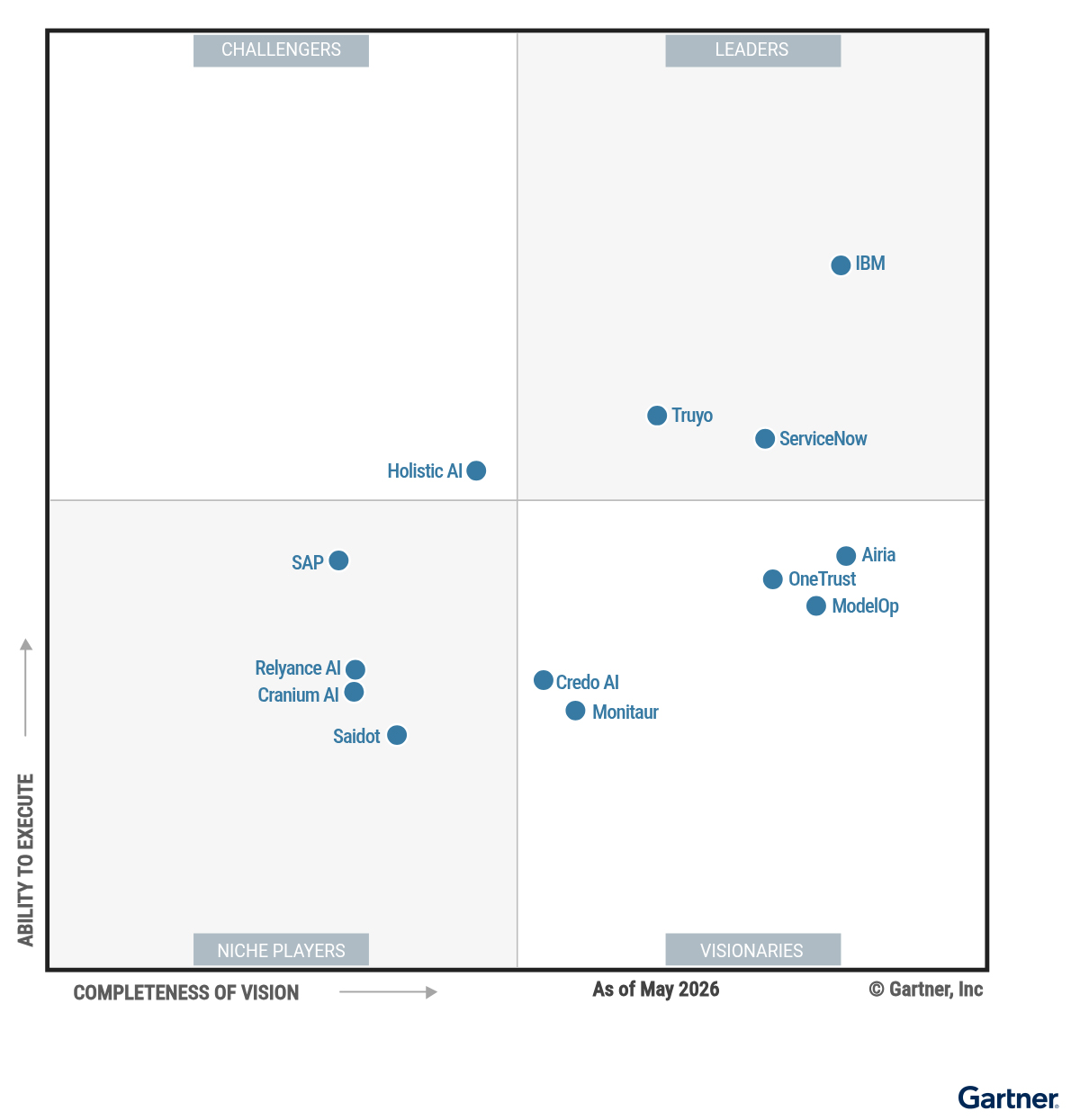
What governance leaders say.
Enterprise programmes in insurance, banking and healthcare, running the platform in production.
We found more AI in the first session than our register had listed in two years. That changed the conversation with the board.
Our EU AI Act evidence pack went from a six-week project to an export. The auditor asked how we did it.
It is the first governance tool our data scientists did not route around. The tests run where the work happens.
AI is spreading faster than any governance team can follow.
Every team is adopting AI on its own. Governance still runs on spreadsheets, quarterly reviews and PDFs — so three simple things become impossible.
You can't see it
Around 60% of the AI in a typical enterprise was never registered — models inside SaaS tools, vendor LLMs, agents built on the side.
60% of enterprise AI is shadow AIYou can't test it
Most models are checked once, at launch, if at all. Bias, drift and security failures show up in production — or in the press.
40+ risk dimensions usually untestedYou can't prove it
Policies live in slide decks. Evidence is assembled by hand in the weeks before an audit, then goes stale the day after.
0 systems with continuous evidenceUngoverned AI is not free.It's just unbilled.
Fines are the visible line. The larger costs are slower launches, duplicated reviews, and the one incident that puts every other AI project on hold.
See how governance pays for itselfOne end-to-end platform that finds, tests and proves every AI system.
Discovery, inventory, bias audits, red teaming, monitoring, compliance and assurance — Holistic AI connects read-only to where your AI lives and does all of it in one place, so governance keeps pace with the teams shipping AI.
Read-only connectors to cloud, data, MLOps, ticketing and identity, so the registry, the risk scores and the evidence stay current without anyone filling in a form. Nothing to install on your models.
- AWS
- Microsoft Azure
- Google Cloud
- Databricks
- Snowflake
- ServiceNowConnector
- Salesforce
- WorkdayConnector
- Jira
- Confluence
- Slack
- GitHub
- MLflow
- Okta
- Microsoft 365Connector
- SAP
- +Any API · SDK · webhook
Overview Last 30 days
Pull the customers affected by yesterday's pricing error and draft the notification email.
Three modules of one AI governance platform.
Identify, Protect and Enforce share one inventory and one evidence trail. Use them together or start with the one your programme needs first.
AI discovery and registry — find every AI system automatically.
Read-only connectors to your cloud, data, SaaS and identity stack build a live AI registry and inventory, including the shadow AI and third-party AI nobody registered.
- AI discovery across AWS, Azure, Google Cloud, Databricks, Snowflake, ServiceNow and more
- Shadow AI and vendor-embedded AI surfaced from real usage, not surveys
- One registry: owner, purpose, jurisdiction, risk classification and dynamic risk score per system
AI risk assessment — audit every system for the risks that matter.
Bias audits, red teaming and 40+ risk tests across robustness, privacy, explainability and security — at onboarding and on every retrain, with dynamic risk scoring across the model lifecycle.
- Bias audits and fairness testing across protected attributes, per use case
- GenAI, LLM and agent red teaming: jailbreak, prompt injection, data leakage
- Continuous monitoring, drift re-assessment and guardrails in production
Policy, workflow and evidence — turn every finding into a named control.
Policy packs per framework, conformity and impact assessments, approval workflows in your pipeline, and an audit trail written as work happens — reported per framework, jurisdiction and business unit.
- Control library mapped to EU AI Act, ISO 42001, NIST AI RMF, NYC LL144, Colorado SB 205
- Approval workflows and sign-offs routed to the right owner — with the decision, the reviewer and the timestamp recorded automatically
- Conformity & impact assessments with evidence attached
- Audit trail and assurance reporting — audit becomes an export
One platform. Every AI use case.
Governance shouldn't need a different tool for a credit model, a vendor copilot and an autonomous agent. One registry, one control library, one evidence trail — applied to whatever your teams ship.
Governance that knows your industry.
A claims model in EU insurance and a marketing agent in US retail are not the same risk. Holistic AI ships control sets mapped to the rules that actually apply to you — so teams inherit the right obligations instead of interpreting them.
See every agent, what it can reach, and what it did.
Agents don't sit still. The agent graph maps each one to the tools it can call and the data those tools touch — and flags the path that shouldn't exist.
AI agent governance: no humans in the loop, until a decision needs one.
Agentic AI acts thousands of times an hour. Holistic AI registers, sanctions and monitors autonomous agents as first-class systems, and its Guardian Agents — Sentinel and Operative — enforce your policies and guardrails in real time, escalating only the judgement calls to a named person.
Sentinel Agents observe
Sentinels sit alongside your agents and read what they do — tool calls, data touched, money moved — scoring each action against the controls you set.
- SeesTool calls, prompts, retrieved data, outbound requests
- ChecksData classification, spend, jurisdiction, approved vendors
- RecordsA timestamped trail per agent, per action
Operative Agents act
Operatives pause, redirect or roll back an action inside the policy window — and escalate only what needs a human, with full context.
- PausesActions that exceed a limit or touch restricted data
- RedirectsTo an approved tool, model or data source
- EscalatesOnly what needs a person — about 1 in 12,000 actions
What changes when governance keeps up.
Governance is usually sold as protection. Done well, it's also the thing that lets you say yes to AI faster.
Deploy faster
Governance review stops being the longest step in every AI launch. Policy gates run in the pipeline, not in a meeting.
Cut regulatory exposure
Every finding maps to a named control in the control library, so you can show a regulator exactly what was checked, when, by whom, and what happened next.
One truth for the board
Risk, security, legal and data science look at the same AI registry, with the same risk scores and the same control status.
Works with your stack
Read-only connectors to cloud, data, MLOps, ticketing and identity. Nothing to install on models, nothing to migrate.
Scale across business units
Roll out by region or division, keep policies consistent, and report per jurisdiction without duplicating work.
Keep your data scientists
Tests run in the tools teams already use, so governance stops being the thing people quietly work around.
Governance data is the sensitive kind.
Your inventory, assessments and evidence describe exactly where your risk is. The platform is built so that information never has to leave your control.
One AI governance platform. Every framework.
Every finding maps to a named control, so evidence for one framework is evidence for all of them. Coverage below is a live example from a governed estate.
EU AI Act
Risk tiers, logging, human oversight and post-market monitoring for high-risk systems. Enforcement from August 2026.
92% of controls passingISO/IEC 42001
The AI management-system standard. Inventories, tiered assessments and decision records map to its controls.
76% of controls passingNIST AI RMF
Govern, map, measure, manage — covered by estate-wide visibility and continuous testing.
88% of controls passingNYC Local Law 144
Annual bias audits for automated hiring tools, with the published summary the law requires.
100% of controls passingColorado SB 205
Duty of care for high-risk AI in consequential decisions; impact assessments and notices.
64% of controls passingSector rules
Model risk (SR 11-7), MDR for medical AI, FCA Consumer Duty and more, mapped to the same evidence.
AI governance resources your board will ask about.
Visit the resource library2026 Gartner® Magic Quadrant™ for AI Governance Platforms
Why Holistic AI was named a Challenger, and how the category is evolving.
What is an AI governance platform?
A plain-English guide for CISOs, CAIOs and risk leaders: what to govern, what to test, what to keep.
EU AI Act: the 12 months before enforcement
What high-risk providers and deployers need in place by August 2026, with a live inventory walkthrough.
Questions about AI governance platforms.
Anything we've missed, ask on the demo — we'll show you rather than tell you.
See your own AI inventory in the first session.
Connect one read-only source and we'll show you what's running — including what nobody registered.