AI Discovery Comes First: You Can’t Govern What You Can’t See

Most enterprises are running far more AI than leadership realizes. When Holistic AI’s automated discovery is applied, the true footprint is typically 30–50% larger than expected, revealing “Shadow AI,” duplicated tools, hidden LLM workflows, and unmonitored third-party AI features that never appear on spreadsheets or self-reported inventories.
Discovery is not step three or step five of governance. It is step zero.
Until you know what exists across environments, every other governance function, including risk classification and mitigation, compliance, auditing, and ongoing monitoring, rests on incomplete or incorrect assumptions.
Shadow AI Is Everywhere - and Mostly Invisible
Shadow AI isn’t malicious; it’s emergent. It happens unintentionally because modern AI is embedded everywhere, evolves fast, and teams move faster than governance processes. Common examples include:
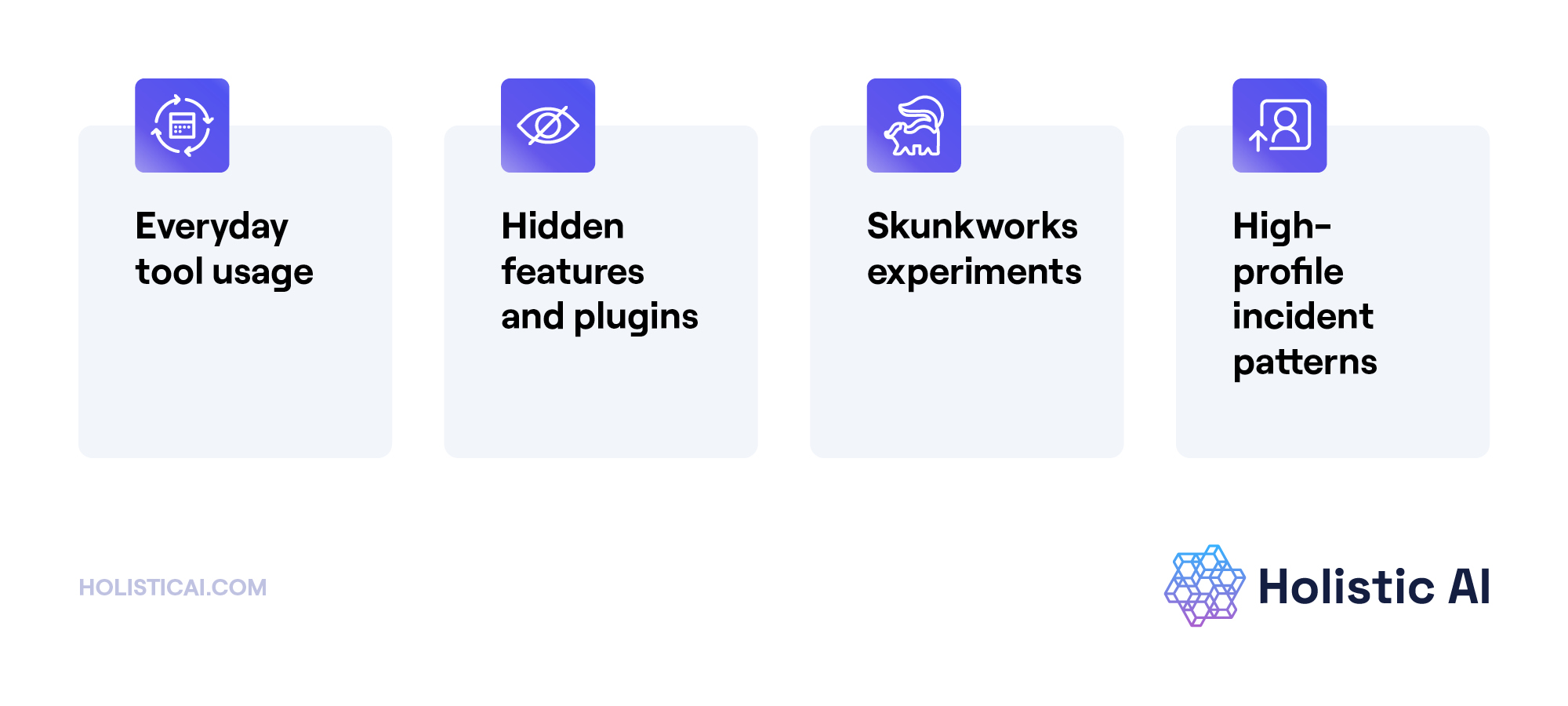
1. Everyday tool usage
An employee pasting confidential contracts, pricing sheets, or client data into a public chatbot to “clean up wording” before a meeting. Or a developer using an unvetted coding assistant to generate infrastructure scripts or SQL against sensitive databases.
2. Hidden features and plugins
Staff turning on “AI copilot” features (which are everywhere) inside approved SaaS tools, without any security, privacy, or procurement review. Or browser extensions summarizing email or CRM history while quietly sending content to third-party servers.
3. Skunkworks experiments
A team spinning up its own chatbot or RAG system on a cloud account with no logging or data protections. Or data scientists fine-tuning open-source LLMs on internal datasets in personal sandboxes outside model-risk controls.
4. High-profile incident patterns
Engineers pasting proprietary source code into a public chatbot to debug issues. Or a customer-facing chatbot giving misleading pricing or refund information because no one knew it was live.
Shadow AI is prevalent. You certainly can’t govern what you do not know exists. In this case, ignorance is not bliss.
The Business Costs of Not Knowing
When AI discovery is missing, predictable consequences follow:
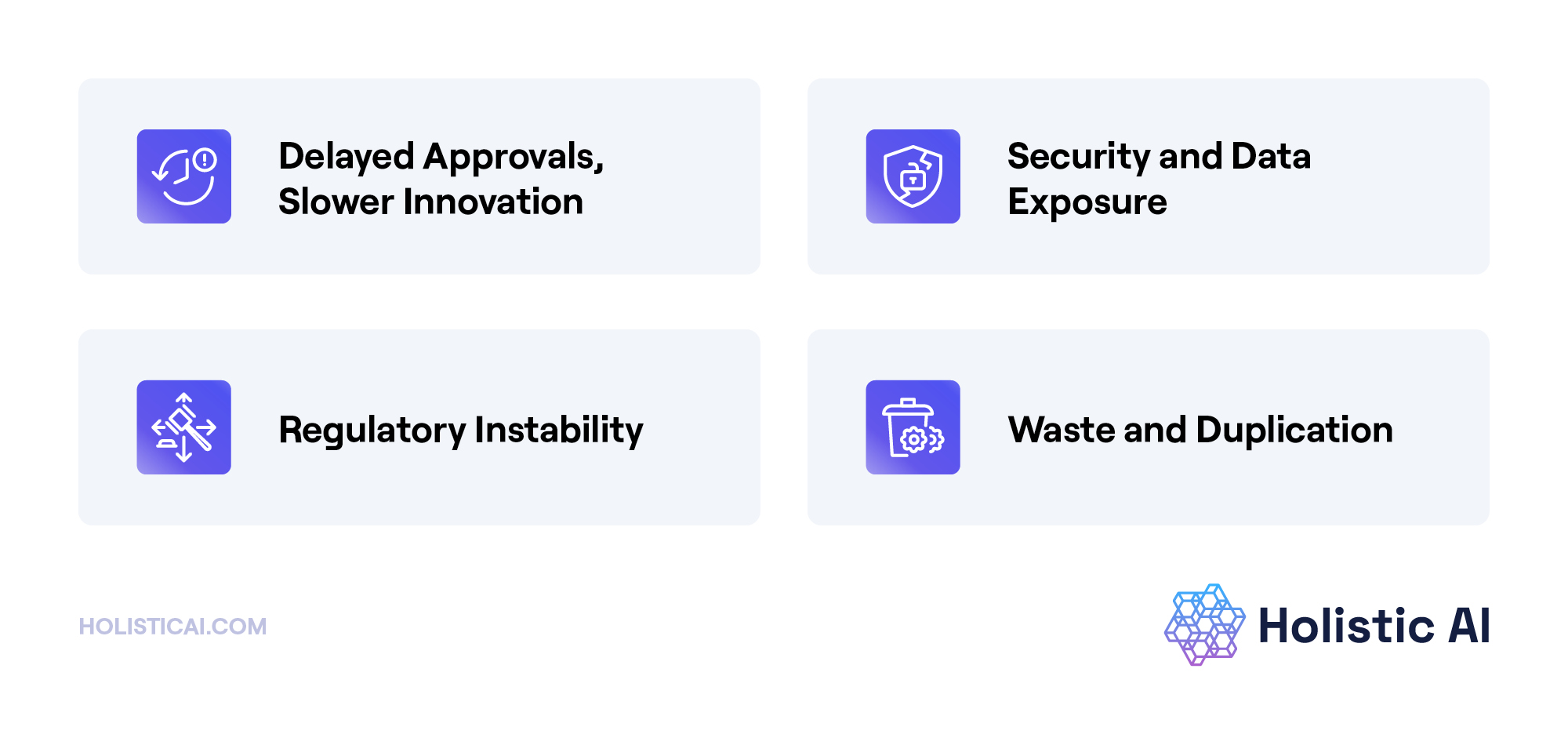
1) Delayed Approvals, Slower Innovation
Risk, legal, and compliance teams first need to “reconstruct” what the system even is. Something that should take hours may take months.
2) Security and Data Exposure
Systems you haven’t discovered can’t be monitored, secured, or tested.
3) Regulatory Instability
The EU AI Act, NIST AI RMF, ISO 42001, Colorado AI Act, NYC Local Law 144—every framework assumes a complete AI inventory. Most organizations do not have one.
4) Waste and Duplication
Multiple teams unknowingly build or buy the same AI capabilities.
What Changes After Real AI Discovery
If you know what AI lives across your organization, who is accountable, and why it is necessary, you have instant visibility into all AI artifacts and their lineage. You’re able to speed up approvals because assets are pre-classified. Potential data exposures are detected before they become incidents. And compliance becomes auditable and defensible. AI Discovery transforms governance from reactive firefighting to operational clarity.
What Discovery Looks Like (Hint: It’s Not Spreadsheets or Surveys)

Effective AI discovery is automated, continuous, technical, multi-modal, and enterprise-wide. Holistic AI’s Discovery module scans across clouds (AWS, Azure, GCP, Databricks, Snowflake), code repos (GitHub, GitLab, Bitbucket), data platforms (S3, Redshift, BigQuery, ADLS), LLM & agent platforms (LangSmith, AgentOps, Copilot Studio), documents (SharePoint, Confluence, Google Drive), and internal/vendor systems (APIs, endpoints, notebooks, logs).
Hidden AI can take many forms which is why Holistic AI identifies AI pipelines, datasets, prompts and prompt logic, agent workflows, RAG components, configuration files, and deployment endpoints. In short: every artifact that influences AI behavior.
The Discovery → Inventory → Ontology Pipeline
Holistic AI pioneered the architecture many enterprises rely on today:

Discovery
Automated identification of AI artifacts.
Inventory
Constructing metadata-rich assets with ownership, lifecycle, and risk classification.
Ontology
Mapping relationships across datasets, pipelines, endpoints, and applications to create a queryable enterprise AI graph.
This is the foundation for meaningful governance.
Why Holistic AI’s Discovery Is Different
Other “AI inventory” tools do static scanning in one domain (just code or just docs). Holistic AI's AI Governance Platform delivers true full-stack discovery:
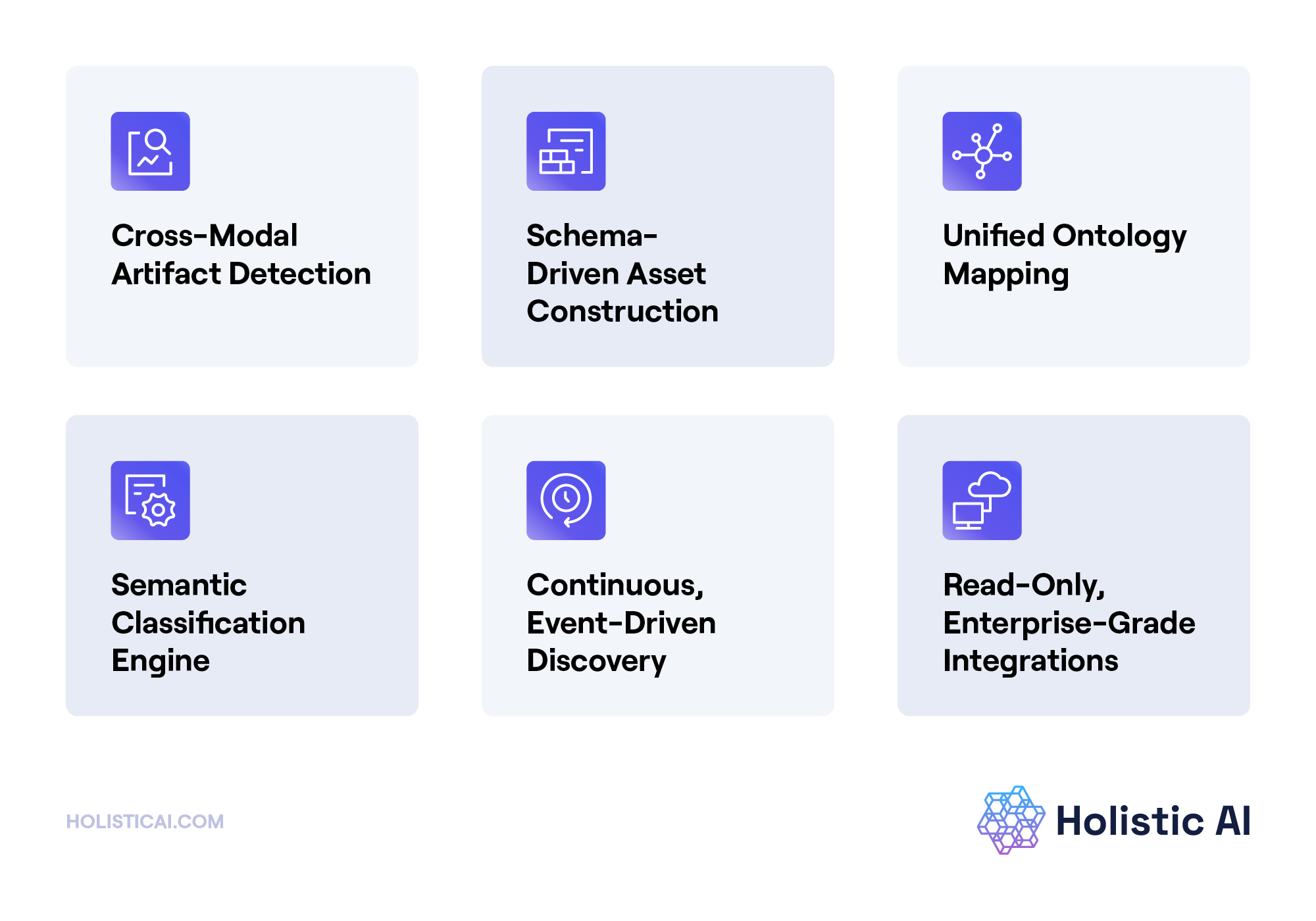
This produces a continuously updated source of truth showing:
- what exists
- who owns it
- how it behaves
- how it connects
- and where risks originate
The Core Truth
AI governance can’t fully perform if you lack visibility into the actual AI that you have in your environment. With AI Discovery, shadow AI becomes visible, compliance becomes possible, risk becomes manageable, and innovation becomes scalable.