AI Risk Management: A Strategic Imperative for the Modern Enterprise

AI is now woven into the operational fabric of modern enterprises - powering everything from customer support chatbots to anomaly detection, credit scoring, and autonomous AI agents. While this ubiquity makes AI a source of competitive differentiation, it also exposes companies to systemic risk when it is deployed without rigorous oversight and structured AI governance controls.
Models can inherit and amplify bias. LLMs can hallucinate, fabricate citations, or disclose sensitive data. AI agents with tool access can execute unintended actions across live systems. At the same time, 87% of organizations say they have already been hit by AI‑driven cyberattacks in the past year, while only around one‑quarter feel highly confident in their ability to detect them.
In short, AI risk management is no longer a compliance checkbox on a spreadsheet - it is a core operational capability for organizations that want to deploy AI safely, meet regulatory requirements, and scale innovation without triggering avoidable incidents, regulatory penalties, or reputational damage.
Effective AI risk management must be embedded across the entire AI lifecycle: from model development and validation to deployment, continuous monitoring in production, and decommissioning.
What Is AI Risk Management?
AI risk management is the discipline of identifying, assessing, and controlling risks across the AI lifecycle. It is a foundational component of modern AI governance frameworks, aligning technical controls with legal, regulatory, cybersecurity, and enterprise risk management requirements.
An effective AI risk management program enables organizations to:
- Prevent harmful outcomes before they propagate to customers, markets or critical systems.
- Meet regulatory requirements such as the EU AI Act, NYC Local Law 144, and emerging sector-specific guidance.
- Align with established frameworks such as the NIST AI Risk Management Framework and ISO/IEC 42001 or your own custom principles.
- Build demonstratable trust with customers, partners, boards, and regulators
- Accelerate AI adoption by reducing uncertainty for product, legal, compliance, and risk teams.
- Avoid costly incidents, enforcement actions, and long‑tail brand damage.
Unlike traditional software, AI systems are probabilistic, data-dependent, and adaptive. Their behavior can change over time due to model updates, data drift, prompt changes, or environmental shifts.
They can also scale errors, security vulnerabilities, or discriminatory outcomes to millions of users in minutes, particularly as attackers increasingly weaponize generative AI and autonomous agents.
Types of AI Risks
Understanding the categories of AI risk is the first step toward managing them.
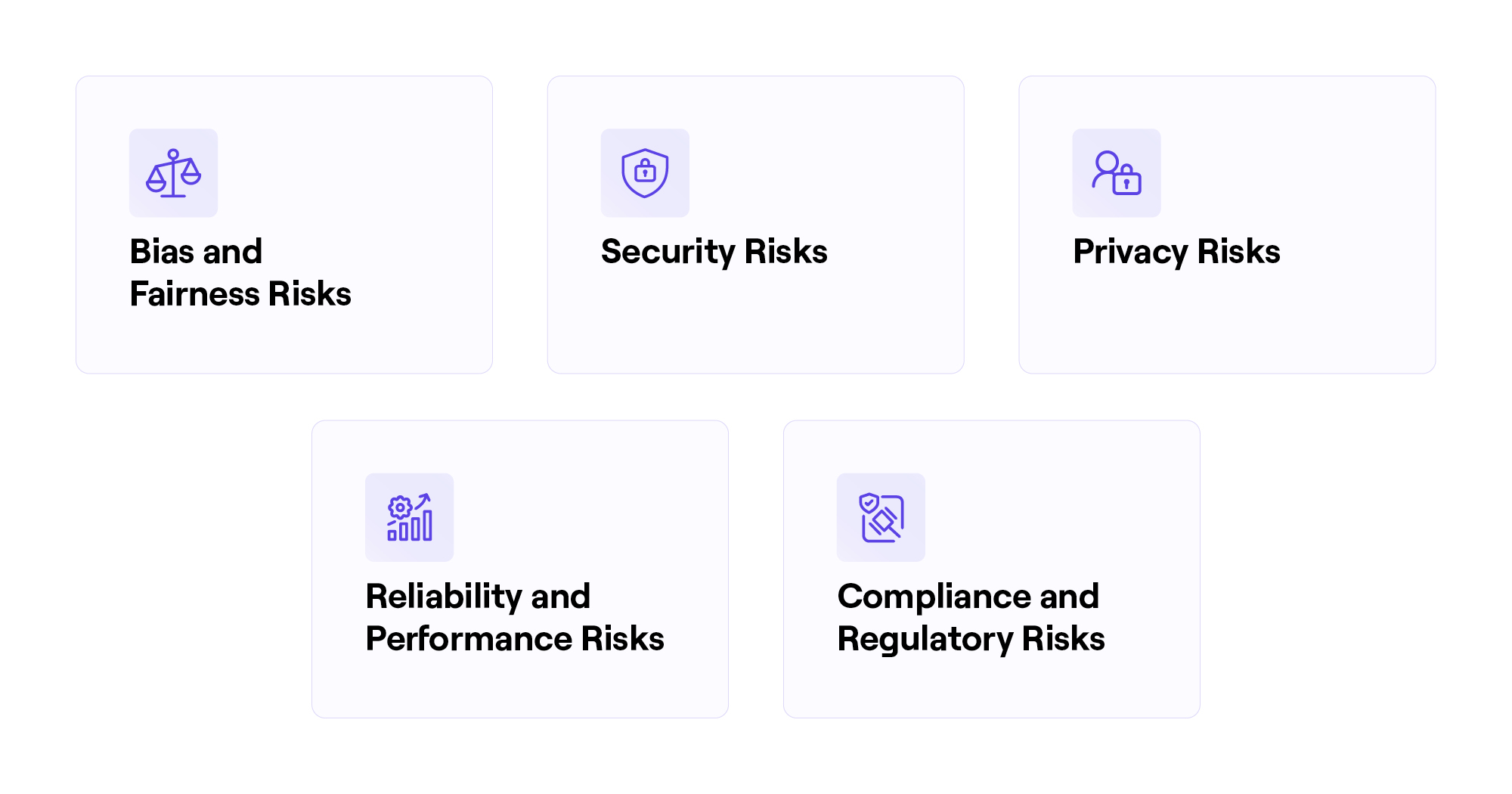
Bias and Fairness Risks
AI systems can perpetuate or amplify biases present in training data. A hiring algorithm trained on historical decisions may discriminate against protected groups. A lending model may deny credit based on proxy variables such as zip code.
These failures are not only ethical concerns; they are regulatory and financial liabilities.
Regulations such as NYC Local Law 144 require bias audits for automated employment decision tools. The EU AI Act classifies certain systems as “high-risk” and mandates structured risk management, fairness evaluation, transparency, and documentation.
Failure to implement fairness testing, model validation, and explainability controls can expose organizations to discrimination claims, class-action litigation, and regulatory enforcement.
Security Risks
AI systems introduce entirely new attack surfaces.
Prompt injection can manipulate LLMs into exfiltrating sensitive data or executing unauthorized actions. Adversarial examples can evade fraud or image detection systems. Model extraction attacks can steal proprietary IP.
The threat environment is accelerating. Recent surveys show that around 87% of organizations report at least one AI‑driven cyberattack in the last year, and over 80% of phishing emails are now generated or enhanced by AI, a more than 50% increase year‑on‑year.
AI security risks now intersect directly with enterprise cybersecurity, zero-trust architecture, and third-party vendor risk management programs.
Without appropriate AI security controls, organizations face:
- Data breaches and ransomware incidents
- Intellectual property theft
- Business interruption and operational disruption
- Regulatory scrutiny for inadequate technical safeguards
Privacy Risks
AI systems frequently process personal, confidential, and regulated data.
Large models may memorize training records. Retrieval-augmented generation (RAG) systems can surface sensitive internal documents to unintended users.
Failure to implement data minimization, access controls, and privacy-preserving model architectures can result in violations of GDPR, CCPA, and sector-specific privacy laws.
The EU AI Act introduces penalties of up to €35 million or 7% of global turnover for serious violations. But fines represent only a fraction of total exposure. Legal fees, remediation programs, mandatory audits, and long-term trust erosion often exceed headline penalties.
Reliability and Performance Risks
AI systems can fail in subtle and unpredictable ways:
- LLM hallucinations
- Model drift as data distributions shift
- Degradation of performance over time
- Failure in edge cases not represented in training data
In high-stakes contexts, such as medical support, autonomous operations, and financial trading, these failures can cause physical harm, financial losses, and regulatory enforcement.
Continuous model monitoring, performance benchmarking, and drift detection are essential components of AI risk management at scale.
Compliance and Regulatory Risks
AI regulation is rapidly shifting from voluntary guidance to enforceable law.
The EU AI Act imposes structured risk management, documentation, logging, transparency, and post-market monitoring obligations for high-risk systems.
Voluntary frameworks such as the NIST AI Risk Management Framework and ISO 42001 are increasingly becoming procurement and board-level expectations.
Organizations unable to demonstrate structured AI governance face delayed approvals, restricted market access, procurement disqualification, and intensified regulatory supervision.
How to Identify AI Risks
You cannot manage what you cannot see. Visibility is foundational.
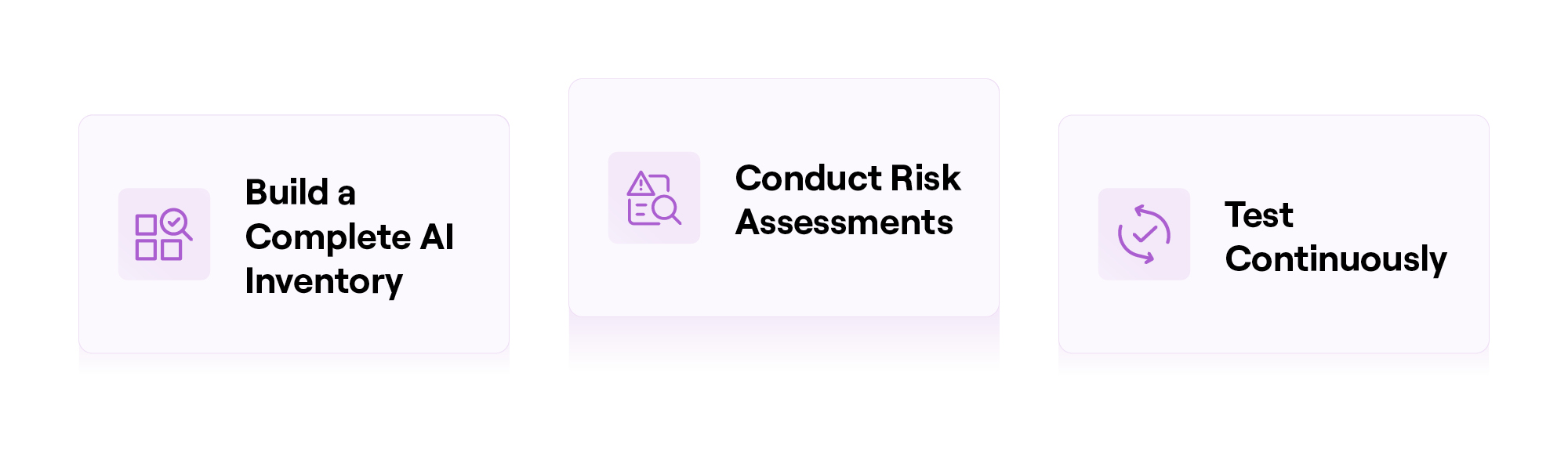
Build a Complete AI Inventory
Most enterprises lack a real-time inventory of AI systems across business units. This includes:
- In-house developed models
- Third-party embedded AI in vendor software
- Generative AI copilots
- Autonomous AI agents
- Shadow AI tools adopted without central oversight
An enterprise AI inventory is the cornerstone of AI governance and regulatory compliance. It should capture:
- System purpose and business owner
- Model type and architecture
- Data sources and sensitivity classification
- Deployment environment
- Risk classification and regulatory applicability
Without this foundation, risk programs remain partial and reactive.
Conduct Risk Assessments
Risk assessments should evaluate:
- Severity of potential harm
- Data sensitivity and regulatory exposure
- Consequence level of automated decisions
- System autonomy and tool access
- Alignment with corporate risk appetite
Risk assessments should integrate with existing Enterprise Risk Management (ERM), and Model Risk Management (MRM) to avoid siloed oversight. Assessments must be systematic, repeatable, and auditable, not static documents created once and forgotten.
Test Continuously
AI risks evolve over time. Point-in-time audits are insufficient. Continuous testing and red-teaming should evaluate:
- Fairness across protected attributes
- Prompt injection resilience
- Jailbreak vulnerabilities
- Data leakage and privacy exposure
- Model extraction risk
- Drift against performance KPIs
For AI agents, testing should simulate realistic attack chains involving tool use, system access, and multi-step reasoning. Continuous AI testing is a core capability of production-grade AI governance.
How to Prevent and Mitigate AI Risks
Identification without control is incomplete.
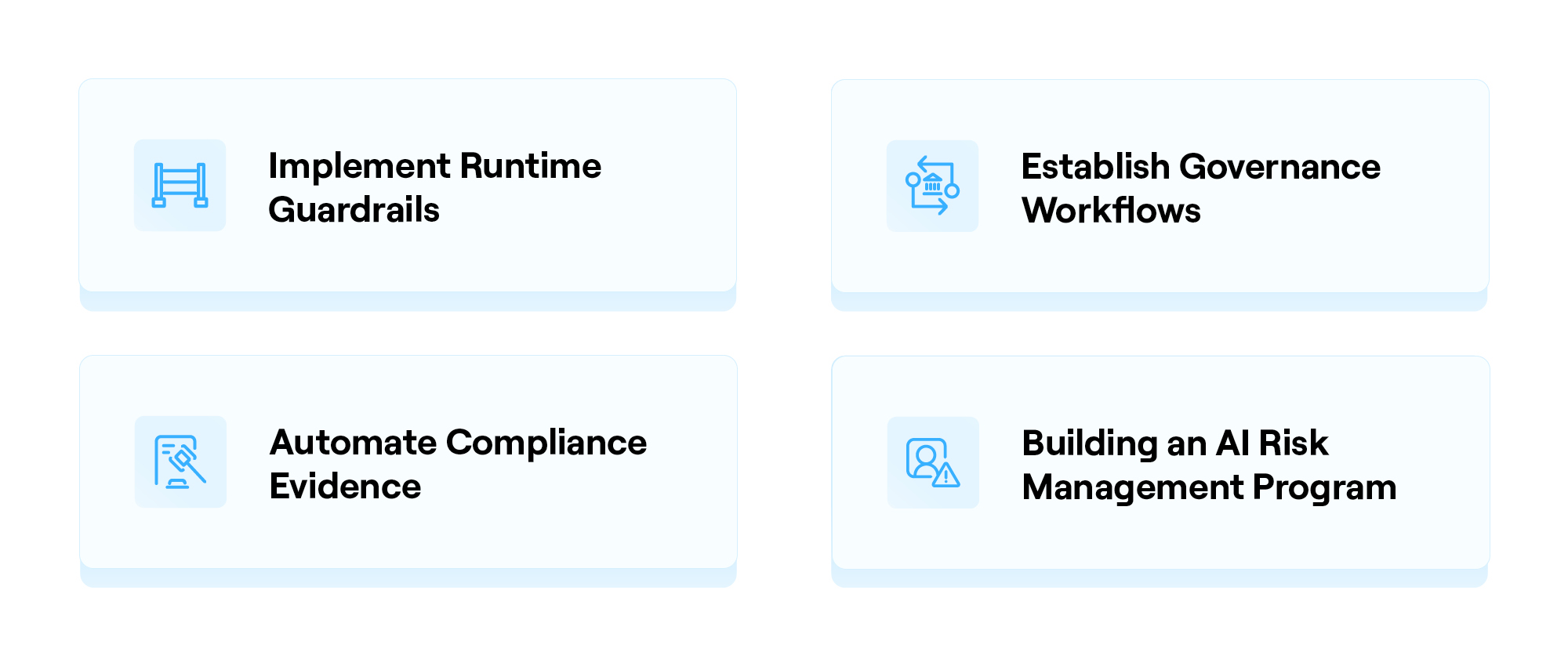
Implement Runtime Guardrails
Guardrails are real-time enforcement mechanisms that constrain AI behavior.
They can:
- Filter harmful or policy-violating outputs
- Block malicious inputs
- Redact sensitive information
- Restrict tool permissions
- Log all high-risk actions
For AI agents with system access, guardrails define permissible actions and enforce least-privilege principles. Without runtime controls, a single compromised prompt can cascade across systems.
Establish Governance Workflows
AI governance requires structured workflows with defined accountability.Workflows should specify:
- Review requirements at each lifecycle stage
- Approval thresholds for high-risk systems
- Escalation processes
- Evidence documentation standards
This creates defensible audit trails required under emerging AI compliance regimes.
Automate Compliance Evidence
Manual compliance processes do not scale with AI velocity.
Automated capabilities should:
- Map AI systems to regulatory obligations
- Track control implementation
- Monitor testing status
- Generate audit-ready documentation on demand
Automation reduces regulatory exposure and shortens incident recovery timelines.
Building an AI Risk Management Program
AI risk management is not a one-time project. It is a continuous operational discipline. To build maturity, organizations should:
- Maintain end-to-end visibility into all AI systems
- Embed risk controls across the AI lifecycle
- Implement continuous testing and monitoring
- Deploy runtime guardrails for LLMs and AI agents
- Integrate AI governance into SDLC, ML Ops, and DevSecOps pipelines
- Automate compliance reporting aligned with frameworks such as the EU AI Act and NIST AI RMF
Organizations that operationalize AI risk management will:
- Deploy AI faster
- Reduce disruptive incidents
- Strengthen regulatory defensibility
- Improve board-level confidence
- Unlock access to regulated markets
Those that neglect it risk compounding losses: AI-enabled cyberattacks, enforcement penalties, operational disruption, and long-term brand erosion. AI risk management is not about slowing innovation. It is about enabling durable, defensible AI adoption at enterprise scale.
We can help
Holistic AI provides a comprehensive, highly automated AI governance platform designed to operationalize AI risk management across the enterprise.
From AI discovery and inventory management to structured risk assessments, continuous testing, runtime guardrails, and automated compliance evidence, we help organizations transform AI governance from a reactive obligation into a strategic capability.
If your organization is evaluating how to implement enterprise-grade AI governance, AI compliance, or AI risk management aligned with the EU AI Act and global frameworks or your own organizational principles and values, our platform enables you to move from visibility to control at the speed and scale of AI.