Don’t Throw Good Agents After Bad: Smarter Agentic AI Deployment

How to Deploy Agentic AI More Intelligently with Observability, Visualizations, and Governance
Agentic AI moved from demos to deployment in 2025, and it shows no signs of slowing down. AI agents that can plan, reason, and act are already being used to automate workflows and accelerate decision-making. In fact, many organizations are experimenting with multi-agent systems to scale that capability across teams and functions, according to McKinsey.
So, it might seem logical to start deploying agents across your environment now to achieve greater efficiencies sooner rather than later. But that’s only half the story. Scaling agentic AI is not the same as adding more agents. In real-world settings, the instinct to add more agents can backfire, leading to a greater management overhead, less efficient architecture, and inflated token spend and cost.
New research published by Google and MIT suggests a more measured response. The study finds that the effectiveness of multi-agent systems depends heavily on the type of application. And, pushed beyond the correct threshold, more agents can mean worse outcomes.
The Experiment
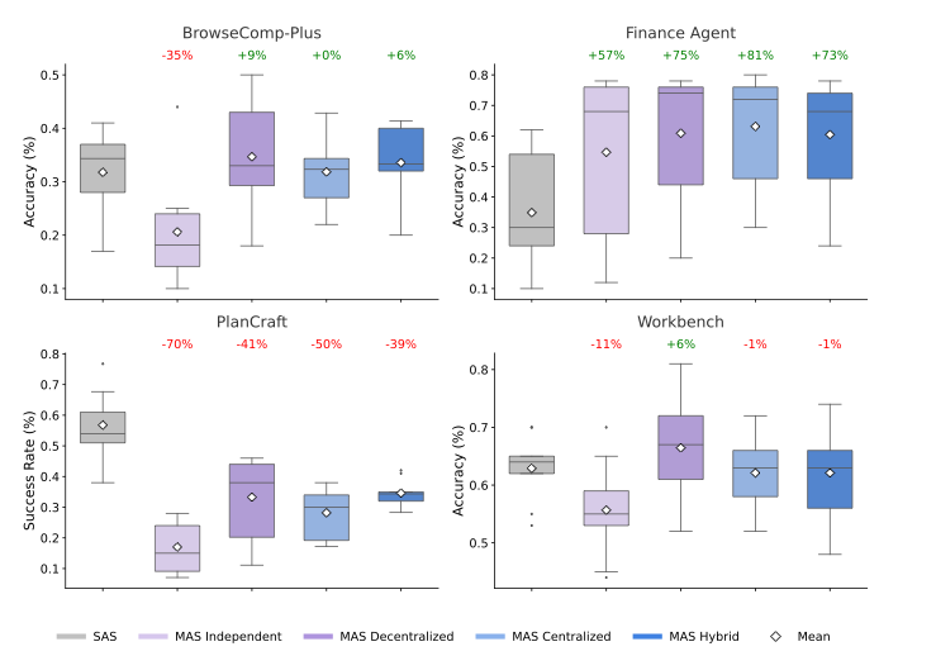
Google and MIT ran 180 experiments testing the effectiveness of adding agents using models from OpenAI, Google, and Anthropic—under the same prompts and token budgets. The findings were clear:
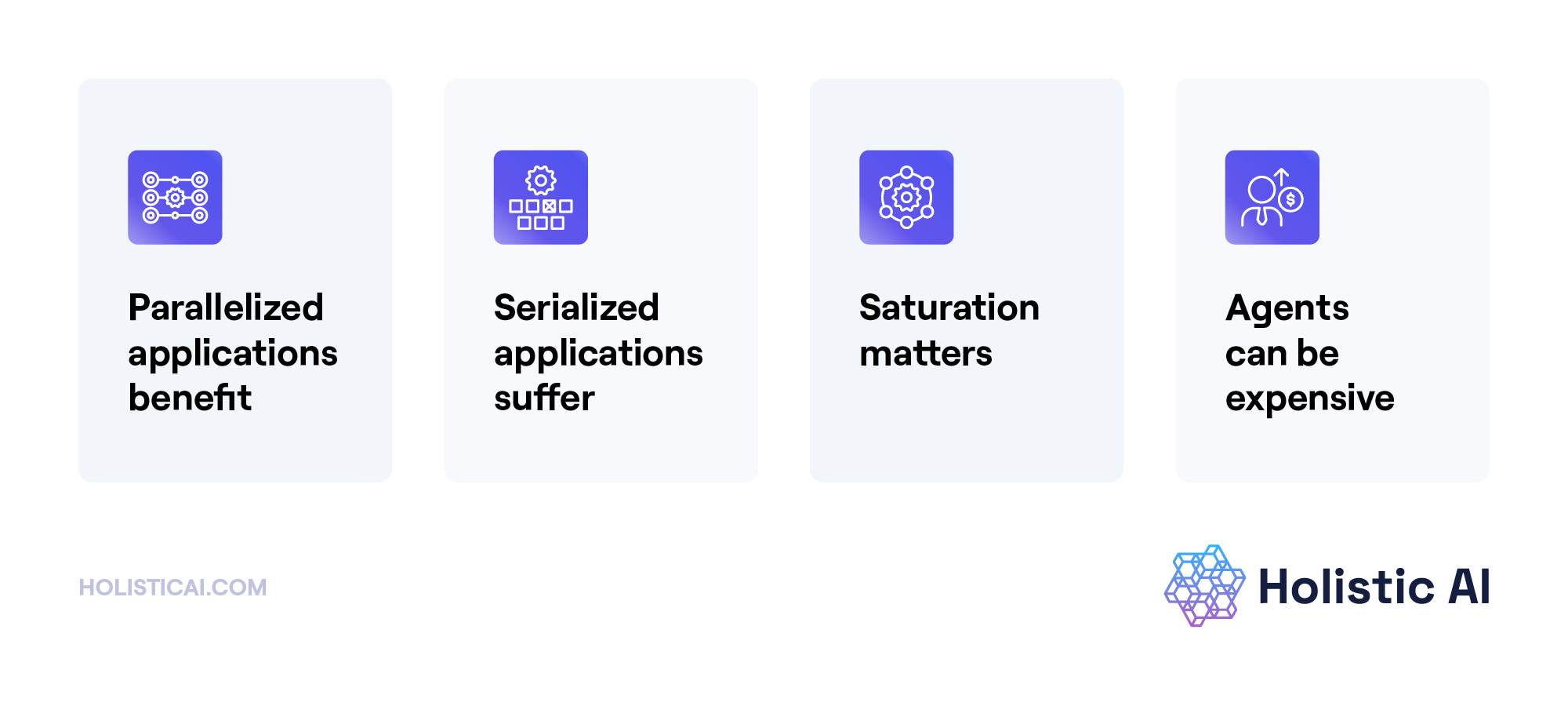
- Parallelized applications benefit - Workloads that could take advantage of highly parallelized processing, like financial analysis, saw performance gains of up to 81% over a single-agent baseline. Multiple agents were able to look at sales trends, cost structures, and market data in parallel and then merge results.
- Serialized applications suffer - Tasks that require a step-by-step workflow, like Minecraft planning, saw a performance degrade by up to 70%. Each action changes the inventory that later actions depend on, and these sequential dependencies don't split well across multiple agents.
- Saturation matters - Once a single agent achieves a success rate of approximately 45% on a task, adding more agents typically degraded performance. Coordination costs cause multiple agents to rapidly burn through tokens.
- Agents can be expensive - When the researchers tracked tasks completed per token budget, single agents averaged 67 successful tasks per 1,000 tokens. Centralized multi-agent systems managed just 21, while hybrid systems completed only 14. The culprit: management overhead.
The Takeaway
Scaling agentic AI is not just about adding more agents—it’s about understanding how, when, and where they add value. Agentic AI needs observability before it needs more agents.
Ultimately, the performance of agentic AI at scale requires the ability to observe, visualize, and diagnose how agents behave in practice. It’s all about architecture-task fit and the ability to measure coordination overhead, redundancy, and error propagation in production-like conditions.
From Agent Chaos to Agent Clarity
As organizations experiment with multi-agent environments, many discover a new challenge: coordination complexity.
Performance bottlenecks, redundant processing, and ballooning token consumption often stem from invisible inter-agent dependencies.
That’s where Holistic AI fits in.
Holistic AI provides living, dynamic visualizations of the entire agentic ecosystem—showing exactly how AI agents connect, communicate, and depend on each other. It maps their workflows, accountability paths, and performance bottlenecks.
When agentic performance drops or costs spike, Holistic AI pinpoints where and why—helping teams troubleshoot faster, optimize architectures, and right-size deployments for performance and cost.
Organizations gain the ability to deploy smarter, instead of attempting to throw inefficient and expensive resources at their performance issues.
Governance Is the Foundation
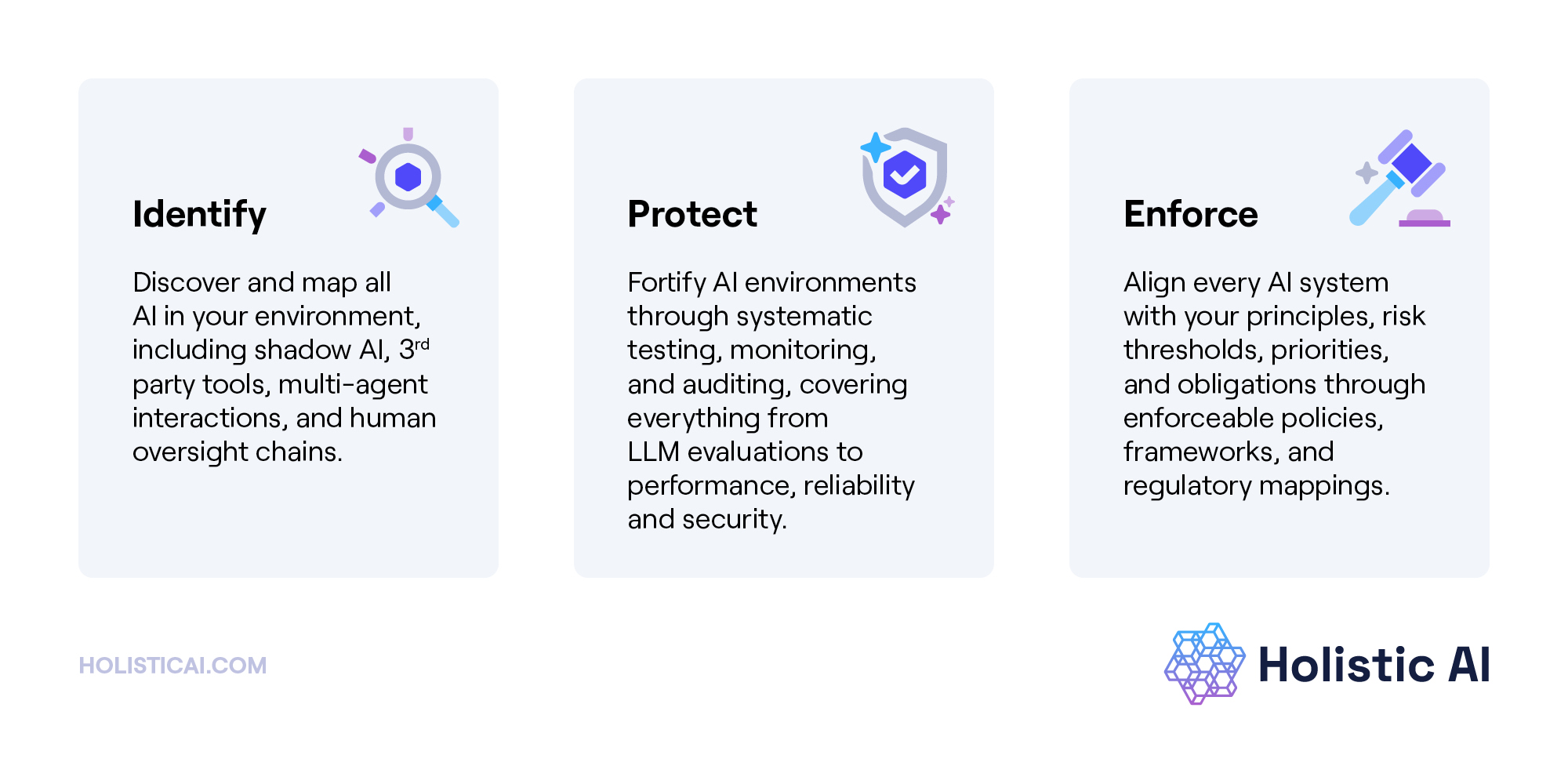
Optimizing agentic AI for given workloads is only part of the story. Sustainable agentic AI also requires governance: continuous visibility, testing, monitoring, and enforceable controls across the AI lifecycle, especially as agents interact with tools, data, and people. That’s why Holistic AI’s Governance Platform provides end-to-end lifecycle oversight, helping organizations manage the complexity of modern AI systems responsibly and efficiently.
The Bottom Line
Agentic AI delivers enormous potential—but only when deployed thoughtfully. More agents are not inherently better. Without visibility, coordination costs can erode performance, inflate costs, and slow innovation.
The organizations that succeed will be those that understand how their agents behave, where they add value, and when they become a liability.
With Holistic AI , teams gain the visibility, governance, and control needed to scale agentic AI responsibly, cost effectively, and with confidence.