New

Holistic AI named a Challenger in the 2026 Gartner® Magic Quadrant for AI Governance Platforms

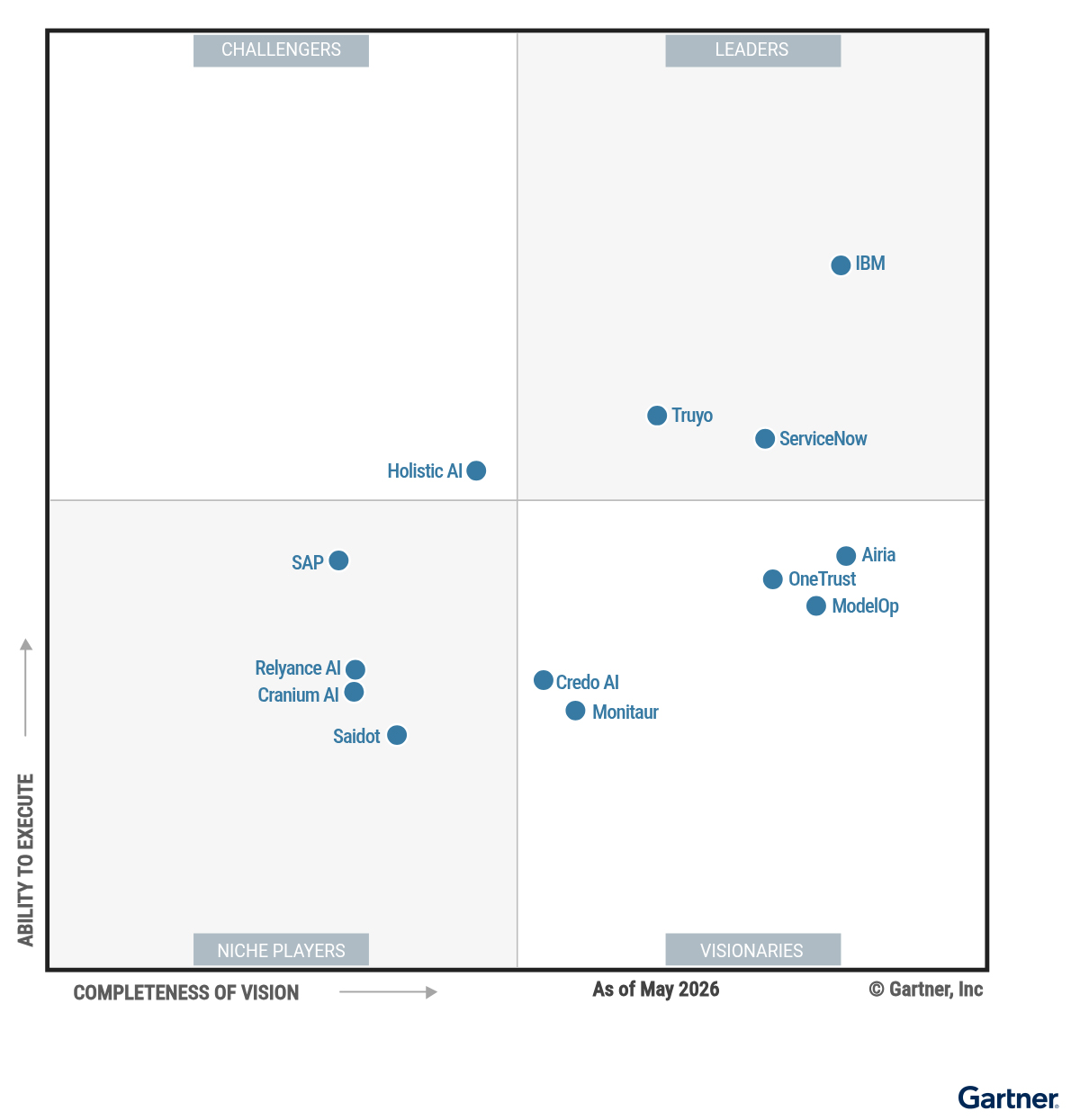
Gartner has evaluated 13 vendors in its inaugural Magic Quadrant for AI Governance Platforms. Holistic AI has been recognized as a Challenger.

Download the report to see the Gartner evaluation of the AI governance platform market, the vendors evaluated, and the strengths and cautions Gartner identified for Holistic AI.

Gartner Magic Quadrant for AI Governance Platforms, 2026.

AI governance is becoming an enterprise platform category

AI is moving faster than traditional governance can keep up.

Gartner says AI governance platforms are designed to centrally define, approve and enforce responsible AI policies across comprehensive AI use cases, applications and agents. As an emerging market, these platforms are essential for operationalizing responsible AI throughout an organization’s entire AI ecosystem.

Gartner predicts that by 2027, “AI governance will become a requirement of all sovereign AI laws and regulations worldwide.” Gartner also predicts that AI governance and responsible AI capabilities will be part of 75% of AI platforms by 2027, making them the main area of competition.

As AI moves into production, governance has to move with it. Manual processes and periodic reviews cannot keep pace with systems that change and act in real time.

One platform to Identify, Protect and Enforce

Holistic AI gives enterprises one governance layer across the AI lifecycle, from discovery and risk assessment to policy enforcement in production.

Identify.

Discover and maintain a live inventory of AI across the enterprise, including models, applications, agents and third-party AI. Connect systems to their owners, dependencies and policies so governance starts with a current view of what actually exists.

Protect.

Assess AI for bias, robustness, privacy, security and other risks before deployment, then monitor it in production. For agentic systems, Agent Graph maps the relationships among agents, tools, tasks and data so organizations can assess the system as a whole, rather than one model at a time.

Enforce.

Turn governance policies into controls. Automate approval workflows and governance gates, map controls to regulatory requirements and standards, maintain audit evidence, and apply controls as AI moves into production.

Together, we believe these capabilities address core functions Gartner identifies for AI governance platforms, including AI discovery and registry, compliance risk management, policy management and enforcement, dynamic risk scoring, evidence collection and interoperability.

Govern AI at runtime

AI agents can reason, call tools, access data and take actions in real time. Governance has to operate at the same speed.

Holistic AI is extending its approach to runtime governance with Guardian Agents. Sentinel Agents monitor AI behavior and detect risk. Operative Agents are designed to intervene when defined policies or thresholds are breached, governing what an AI system can access and what actions it can take.


Our perspective on the Gartner evaluation

As AI becomes more autonomous, governance has to become continuous. Our focus is building the infrastructure enterprises need to know what AI they have, understand its risks and enforce their policies when and where it matters, on an ongoing basis.

By clicking “Accept”, you agree to the storing of cookies on your device to enhance site navigation, analyze site usage, and assist in our marketing efforts. View our Privacy Policy for more information.