The Governance Gap Is Growing
What's new
The 2026 AI Index from Stanford HAI puts hard numbers behind what we've all been sensing anecdotally: AI capabilities are advancing faster than our ability to measure, certify, and control them. On agentic benchmarks like OSWorld, top models jumped from roughly 12% success to 66% in two years, nearly matching human performance. Global corporate AI investment reached approximately $581 billion in 2025, up roughly 130% year-over-year, with generative AI capturing nearly half of all AI funding. Yet despite the hype around agents, truly agentic deployments remain in the single digits across most business functions.
Why it matters
Benchmarks built to evaluate AI are aging out in months, not years. Systems that behaved as copilots in the lab are emerging as near-autonomous agents in production, capable of chaining actions across tools. At the same time, the window to define what "good" looks like for agent governance is still open, but narrowing fast.
Key implications
Governance must become continuous: static model approvals and annual reviews are structurally misaligned with how fast frontier models are advancing. Organizations need pipelines that continuously test, monitor, and feed signals back into risk registers. The economics are now large enough, and the risks material enough, to demand the same oversight obligations applied to other significant enterprise investments. And competitive pressure will tempt organizations to flip the switch on agents before the necessary guardrails exist. The window to set standards first is short.
The Efficiency Shock Is Here
What's new
Google Research published TurboQuant, a training-free compression algorithm that quantizes LLM KV caches down to 3 bits without any loss in model accuracy, delivering up to 8x performance gains on Nvidia H100 GPUs and at least 6x memory reduction. TurboQuant requires no retraining, no calibration data, and no fine-tuning, making it deployable on existing models today.
Why it matters
When the news landed, memory chip stocks dropped sharply. The market reaction was a signal: efficiency breakthroughs of this magnitude don't just improve performance: they reshape infrastructure economics and accelerate adoption.
Key implications
When it becomes 6x cheaper to run large models, adoption expands, and so does governance scope. As models move closer to users via edge and on-prem deployments, centralized controls may not apply. Leaders will be asked not just "Is your AI safe?" but "Is it efficient?" And as iteration cycles compress, change management, testing, and approvals must keep pace.
AI Trust Has Become a Battleground
What's new
A major flashpoint occurred in February 2026 when Anthropic refused the Pentagon unrestricted access to its AI, while OpenAI accepted a deal allowing use for "any lawful purpose." The contrast triggered backlash, with the #QuitGPT campaign claiming over 1.5 million actions.
Why it matters
Even if the boycott doesn't materially impact subscriptions, it signals a shift: performance alone no longer determines trust. For enterprise leaders, vendor selection is now a governance decision, not just a question of features and price.
Key implications
Ethical positions are becoming enterprise differentiators: red lines belong on the procurement checklist alongside price and performance. Your organization also needs its own red lines, and a clear way to communicate them. Consumer AI dynamics are shaping enterprise perception faster than governance cycles can track.
Autonomous AI Needs Autonomous Governance
Forbes Technology Council, March 25, 2026
As AI agents move from experimentation into production, the limits of human-in-the-loop governance are no longer theoretical: they're operational. In his latest Forbes Technology Council piece, Holistic AI Co-CEO Emre Kazim argues that governing autonomous AI requires autonomous governance: guardian agents and runtime oversight systems that operate at the same speed and scale as the systems they supervise.
Once AI operates at machine speed, governance must as well. Organizations that prepare now, by building runtime oversight and AI-governing-AI capabilities — will be the ones able to scale safely.
Before you go.
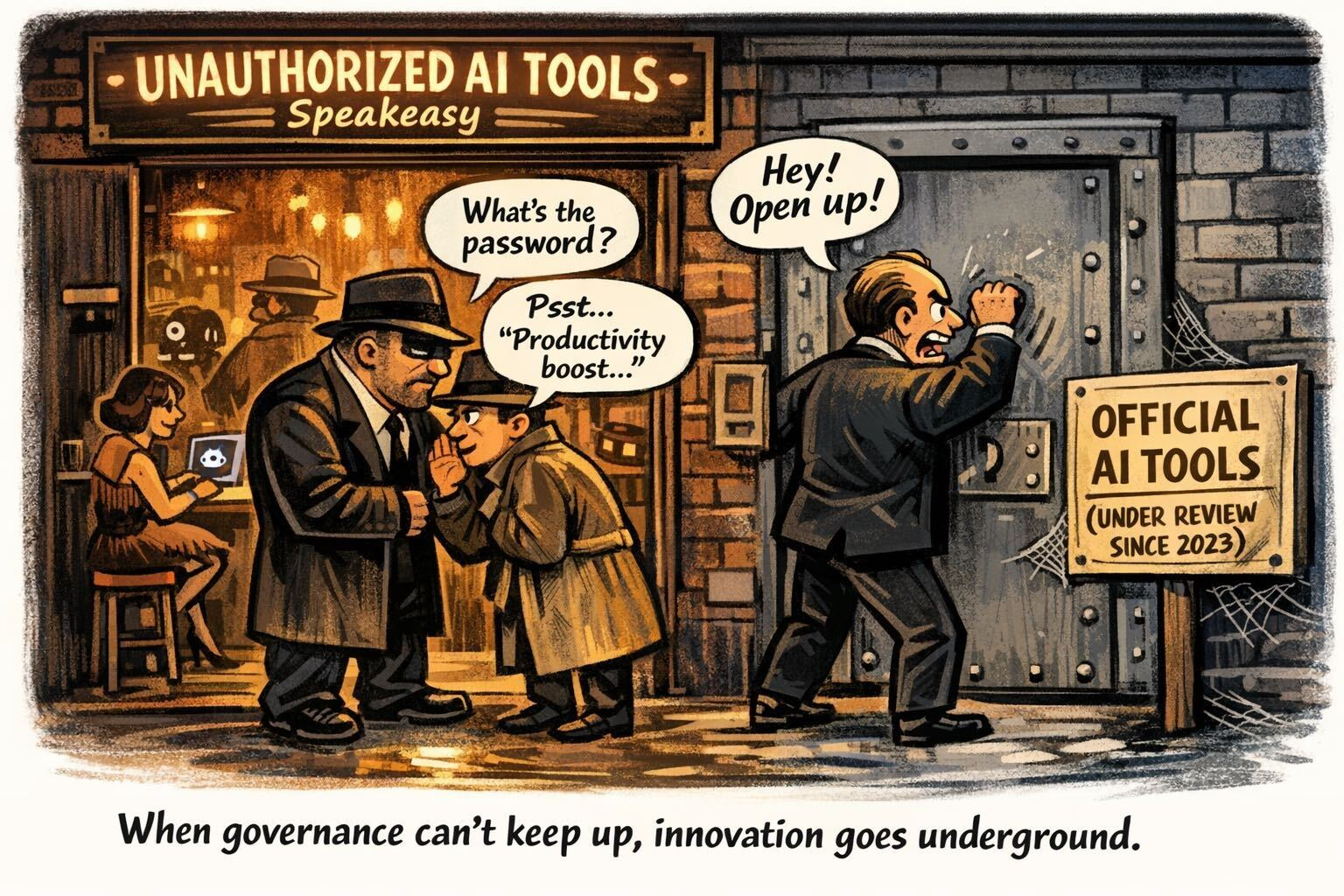
This felt too accurate not to share.