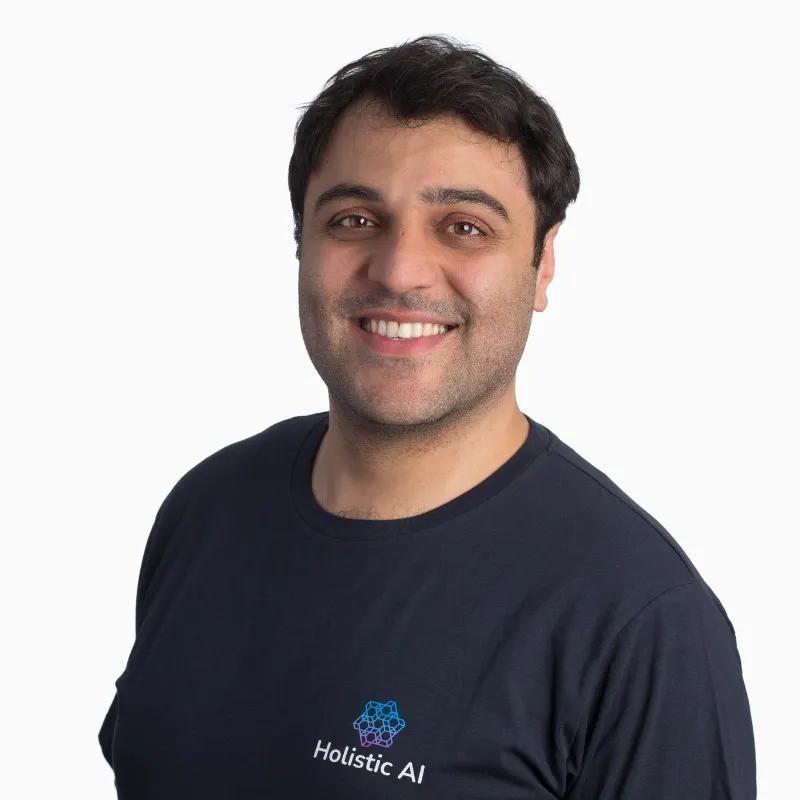


Holistic AI Co-Founder and Co-CEO Emre Kazim sits down with newly appointed Board Member Vahé Torossian, a 31-year Microsoft veteran and enterprise AI investor, to discuss what enterprises are getting wrong about the AI moment, why autonomous agents change everything, and what it takes to govern at scale.
Emre: You've watched several major technology waves reshape the enterprise — client-server, cloud, mobile. How does AI compare?
Vahé: Each wave was disruptive and each one made customers uncomfortable. That's not unique to AI. What is unique is the speed. The interval between "this is emerging" and "this is everywhere" has collapsed. With cloud, enterprises had five to seven years to deliberate. With agentic AI, you don't have that. The train has left the station.
But here's what most people miss: AI isn't just faster than prior waves, it's different in kind. Every previous shift automated a process. Client-server moved where computing lived. Cloud democratized infrastructure. Mobile put a supercomputer in every pocket. AI is beginning to automate judgment. That's a categorically different proposition.
What I find both fascinating and alarming is that the risk is accelerating faster than the innovation itself. Most organizations haven't fully absorbed what large language models can do, and we're already deep into the agentic era — autonomous agents making decisions, triggering workflows, coordinating with other agents, no humans in sight. The stakes are higher and the margin for error is smaller than anything I've seen in thirty years.
Emre: And yet many enterprises are still in a wait-and-see posture. Why?
Vahé: Because they've been burned before. Every technology transformation produces two types of regret: you moved too fast, or you moved too slow. Leaders get blamed either way. So the instinct is to pause, study, run a pilot for eighteen months.
What I learned through many reinvention cycles at Microsoft is that the best leaders don't try to eliminate regret — they embrace a zero-regret strategy. That means making moves today you'll never have to apologize for regardless of how things unfold: building the governance foundation, developing real internal AI capability, learning from the inside out. Those are zero-regret bets. Waiting is not.
And here's the harder truth: in the AI era, you cannot separate transformation from performance. There isn't time to transform first, then perform. That model is dead. The companies who wait are still making a choice, they just don't feel the impact yet.
I watched this same dynamic play out with the cloud transition. Enterprises that waited because they had "perfectly good" on-prem infrastructure didn't stay safe. They fell behind, were disrupted by faster-moving competitors, and spent the next decade in painful catch-up. The risks of moving too slowly are every bit as real as moving too fast. They're just less visible until it's too late.
Emre: Where does governance fit in that picture? Most executives still treat it as an afterthought.
Vahé: It's worse than an afterthought. In most enterprises, governance isn't even on the same roadmap as the AI initiative. The AI team is moving fast, and the governance conversation is happening somewhere else on a slower clock. That's not negligence. It's a structural disconnect.
Ungoverned AI is what will stop companies cold: through regulatory action, reputational failure, or a model producing outputs no one can explain or defend. Many enterprises already have some governance in place, often provided by their model vendor or cloud partner. But that creates a dangerous false sense of security. They've stitched together point solutions, run compliance checklists, checked boxes. The question is whether that design supports speed and scale as agent populations grow. Almost always, the answer is no.
At Microsoft, I watched how seriously we took Trustworthy Computing, not because it was legally mandated, but because we understood that trust was the asset. The enterprises treating governance as a competitive advantage, not a compliance burden, will move faster over a five-year horizon.
What I saw when I joined the Holistic AI board was a platform built for the world that's coming, not just the one we're in now. Governance by design, from the ground up including inventory management, shadow AI detection, regulatory sovereignty, multimodel support, observability, safety, human-agent interaction. All integrated. AI governing AI, at machine speed and scale. That's not a feature set. That's a fundamentally different philosophy.
Emre: You mentioned agents specifically. What changes about governance when it's autonomous agents acting in the world, not just models?
Vahé: Everything. With a traditional AI model, a human reviews the output before anything happens in the real world. With agents, the action is the output. An agent can send an email, execute a transaction, trigger a workflow, interact with a customer, coordinate with other agents, all without a human in the loop. That's not a bug. That's the design.
That changes governance in three fundamental ways. Accountability becomes exponentially harder to trace: if an agent makes a bad decision through a chain of ten sub-actions, who owns that? The blast radius of errors scales dramatically; a bad recommendation gets ignored, a bad action may be irreversible. And the surface area for manipulation expands enormously when agents have real-world permissions and are interacting with each other.
The honest answer is that humans cannot govern agents at scale. The volume, the speed, the interdependencies, it's not possible manually. You need an intelligent control plane. Something that monitors, intervenes, audits, and enforces in real time. Holistic AI anticipated this moment. The platform was architected for the agentic enterprise, not retrofitted for it. When something goes wrong at scale, the difference between designed-in governance and bolted-on governance is the difference between recoverable and catastrophic.
Emre: For a senior enterprise leader reading this, what's the message you want to leave them with?
Vahé: You can't fight gravity. The leaders I've respected most could see where the puck was going, not just where it's been. Right now, most enterprises are responding to what AI is asking of them today. The bolder question is: what will it demand in eighteen months, when agents are embedded across operations and the governance gap has compounded?
This is not a technology decision. It is a leadership decision. The enterprises getting AI right aren't necessarily those with the biggest budgets or the most PhDs. They're the ones where senior leadership is personally engaged: asking hard questions, demanding accountability, ensuring governance and strategy are in the same room at the same time. That cannot be delegated.
The cost of waiting is not zero. The consequences of arriving late to AI governance — regulatory, operational, reputational — are significant and they compound. After thirty years in enterprise technology, the pattern I keep seeing is this: the technology rarely fails. Adoption fails. Culture fails. Leadership attention fails. If you have one foundational choice to make in your AI stack right now, make it here. Build on a foundation designed for scale, for control, for the agentic enterprise. Everything else follows.
Vahé Torossian serves on the Board of Directors of Holistic AI. He is a Venture Partner at Tola Capital and previously served as Corporate Vice President of Microsoft Business Applications and President of Microsoft Western Europe, among other leadership positions.