APRA's AI Letter: A Governance Guide for Australian Banks and Insurers

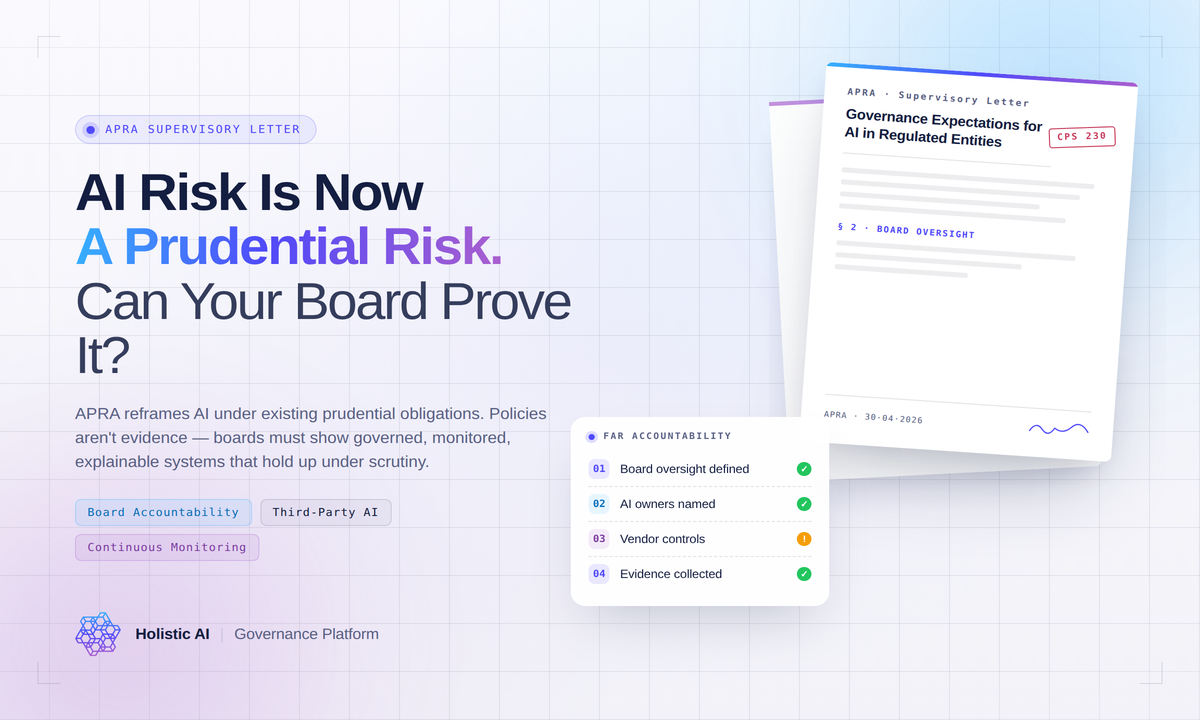
On 30 April 2026, the Australian Prudential Regulation Authority (APRA) wrote to every regulated entity in Australia with a finding that sounds procedural and isn’t: the way banks, insurers, and super funds check whether their AI is working no longer matches how that AI behaves.
Days later, the Australian Securities and Investments Commission (ASIC) reinforced the message, warning firms that AI-driven cyber and operational risks require immediate board-level attention.
AI risk is now a prudential risk. The regulator isn’t asking whether you use AI — it’s asking whether your board can show the systems are governed, monitored, explainable, and resilient, with evidence that holds up under scrutiny.
What is APRA’s AI Supervisory Letter?
APRA’s letter came out of targeted supervisory reviews of large banks, insurers, and superannuation trustees in late 2025. The regulator found AI everywhere — software engineering, claims triage, loan processing, fraud disruption, customer interaction — with governance trailing well behind.
Importantly, APRA reframes AI governance under existing prudential obligations — including operational risk management (CPS 230), outsourcing oversight, and the Financial Accountability Regime (FAR).
This is not a future regulation waiting to be drafted. It is an active expectation inside frameworks institutions already answer to.
APRA highlighted concerns around:
- Weak board oversight of AI systems
- Limited accountability frameworks for AI decision-making
- Inadequate monitoring of model drift and bias
- Third-party and vendor opacity in AI supply chains
- Poor assurance and testing practices
- Operational resilience risks from AI-enabled systems
- Gaps in documentation and explainability
ASIC has echoed the same direction of travel, calling for urgent uplift in cyber resilience as AI accelerates threat sophistication. Together, the two regulators are sending a coordinated signal to Australian boards and executives.
What APRA Expects from Boards and Executives
APRA’s message is straightforward: if AI becomes critical to operations, it must be governed like any other critical risk domain.
In practice, boards and executives will be expected to demonstrate:
- Clear AI governance structures — defined committees, escalation paths, and reporting lines for AI risk.
- Defined ownership and accountability — named accountable persons under FAR for material AI use cases.
- Ongoing AI risk assessments — covering model risk, data risk, third-party risk, and consumer impact.
- Independent assurance processes — internal audit and external review of high-impact AI systems.
- Continuous monitoring and controls — for bias, drift, performance degradation, and security.
- Evidence of oversight — documentation that can withstand supervisory scrutiny.
The work isn’t writing a policy that says AI is monitored. It’s proving how it’s monitored, by whom, against what thresholds, and what happened when a threshold was crossed.
A board paper asserting oversight is no longer enough. APRA wants the evidence underneath it.
What This Means for Banks, Insurers and Super Funds
Australian financial institutions are already deploying AI across a wide range of high-stakes use cases, including:
- Claims automation and triage
- Fraud detection and AML monitoring
- Credit and lending decisions
- Customer support and virtual assistants
- Risk modelling and capital calculations
- Internal copilots and productivity tools
- Underwriting and pricing
The challenge is simple. Most institutions adopted AI faster than they built governance capability around it. That creates several immediate exposures.
1. Board Accountability Risk
Under FAR, named individuals can be held responsible for AI failures within their domain. APRA observed strong board interest in AI’s upside and a thinner grasp of its risks, with directors leaning on vendor presentations rather than independent challenge.
A board that approves AI initiatives without the literacy to question them is now an accountability problem with a name attached.
2. Third-Party AI Risk
APRA saw entities depending on a single provider across multiple use cases, with few testing what happens if that provider fails or needs replacing. Embedded AI makes the supply chain opaque — foundation models, training data, and fourth-party services sit upstream, where entities can’t easily assess performance, bias, or security.
Under CPS 230, material service provider arrangements — including AI vendors — require active oversight, not contractual reliance.
3. Automated Decision-Making and Privacy Reform
Australia’s broader privacy reforms are moving toward stronger obligations around automated decision-making transparency.
As these reforms evolve, institutions will need stronger controls around explainability, human oversight, bias detection, data governance, and consumer transparency — particularly where AI affects credit, insurance, or claims outcomes.
4. Operational Resilience Risk
AI fails in ways legacy systems don’t. It hallucinates, it degrades silently, it can be poisoned or injected.
CPS 230 obligations on operational resilience now extend to these failure modes. Where AI supports critical operations, APRA wants credible fallback processes that have actually been tested, not assumed.
Australia Is Aligning with a Global Direction
APRA’s expectations do not exist in isolation. Australia is aligning with global AI governance frameworks — the EU AI Act, UK FCA and PRA guidance, the NIST AI Risk Management Framework, ISO/IEC 42001, and MAS AI governance guidance in Singapore.
The common theme across regulators is consistent: AI governance must become operational, measurable, and auditable. Policies alone are not enough.
Institutions need evidence — captured continuously, across the full AI lifecycle.
What Australian Firms Should Do Next
The institutions moving fastest aren’t waiting for prescriptive legislation. They’re already:
- Conducting AI governance gap assessments against APRA expectations
- Building a centralized AI inventory across first- and third-party systems
- Mapping AI systems to regulatory obligations under CPS 230, FAR, and Privacy Act reforms
- Formalizing board and executive reporting on AI risk
- Establishing independent AI assurance processes
- Reviewing third-party AI dependencies and vendor controls
- Implementing continuous monitoring for bias, drift, and performance
How Holistic AI Helps
This is the work Holistic AI was built for. The platform gives institutions a centralized AI inventory, continuous monitoring for drift and bias, explainability and red-teaming evaluations, and audit-ready evidence collected across the AI lifecycle.
Establish AI Governance and Accountability
- Centralized AI inventory and system mapping
- Role-based governance workflows aligned to FAR accountability
- AI risk classification and ownership
- Policy management and controls tracking
Monitor AI Risk Continuously
- Bias and fairness testing
- Drift and performance monitoring
- Explainability assessments
- Security, robustness, and red teaming evaluations
Strengthen Third-Party AI Oversight
- Vendor AI risk assessments and due diligence workflows
- Documentation and evidence management
- Ongoing monitoring of external AI systems and sub-processors
Improve Auditability and Assurance
- Automated reporting and governance dashboards
- Audit-ready documentation for internal audit and regulators
- Board-level reporting templates
Align to Global and Local Frameworks
- NIST AI Risk Management Framework
- ISO/IEC 42001
- EU AI Act readiness
- Internal governance standards
The point isn’t compliance for its own sake. It’s a governance posture a board can defend, a regulator can test, and a customer can trust.
APRA has said it will move from observation to supervision, with stronger action where entities fail to manage AI risk proportionately. That shifts the question facing every board. It is no longer acceptable for your AI governance to read well on paper. It must hold up when someone tests it.
The institutions that treat governance as something they can prove, continuously — rather than something they wrote down once — are the ones that will still be running their AI when that test comes.