Shadow AI Discovery: Risk Scoring, Staging & One-Click Reconciliation

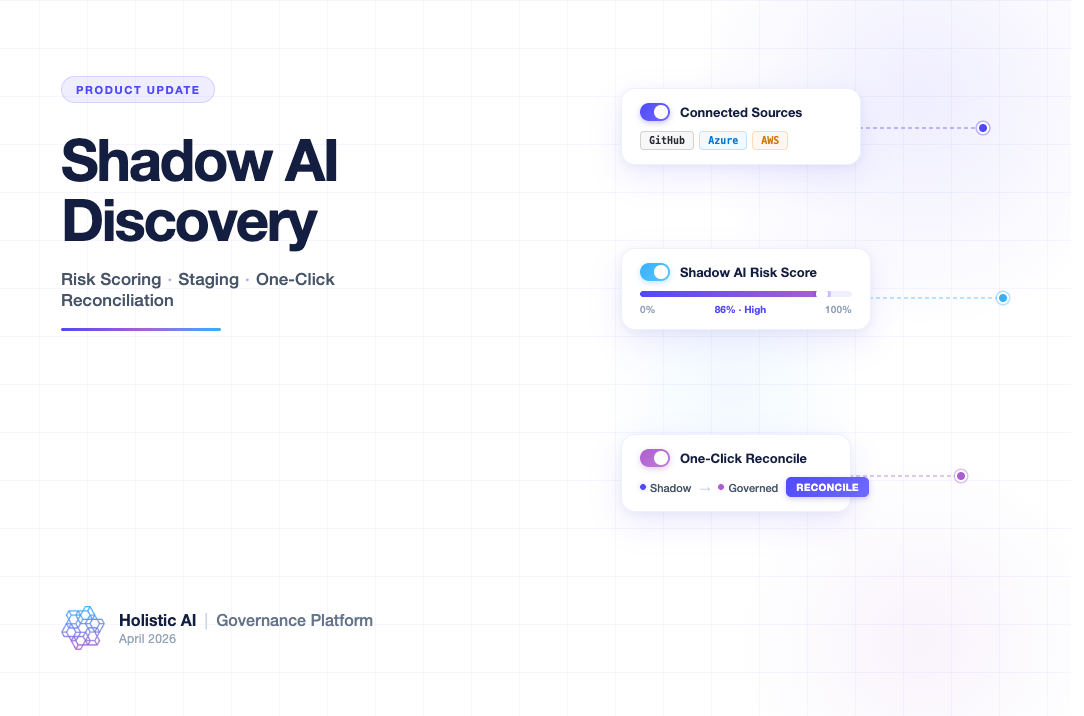
AI doesn't enter organizations through one front door. It comes in through dozens of them.
A model deployed on AWS SageMaker. An inference endpoint spun up in Azure. A GitHub repository quietly importing an LLM SDK.
A third party tool integrated by a product team on a Tuesday. Each of these is an AI system. None of them may have gone through a governance pathway. And without active detection, your governance team will never know they exist.
That fragmentation is the actual problem. Not a lack of effort. A lack of visibility. Governance teams can't govern what they can't find, and they can't find what's scattered across cloud platforms, code repositories, ML platforms, SaaS tools, and internal systems with no centralized record.
Once visibility is established, three new friction points show up immediately:
- Risk ranking. An internal developer script and a client facing recommendation engine processing sensitive customer data appear in the same list. Nothing distinguishes them by consequence.
- Dedicated queue. Discovered ungoverned assets land alongside governed ones in the main inventory and are hard to distinguish. Governance teams filter and sort instead of making decisions.
- Fast path to governance. Acting on a shadow AI asset meant creating a new inventory item, re-entering metadata, and standing up workflows manually, every time.
Holistic AI has just closed all three gaps with the latest release of our AI governance platform.
What the Holistic AI Governance Platform already does
Shadow AI Discovery in the Holistic AI Governance Platform was built to close the visibility gap. It connects to 50+ sources across your entire infrastructure: cloud platforms, code repositories, ML platforms, LLM providers, agent frameworks, documentation systems, and enterprise SaaS. And, it scans your environment continuously.
When it finds AI, it doesn't just flag individual files. It collects the artifacts, classifies them, maps the relationships between them, and groups everything into a single unified asset record. A model file in S3, a configuration in a repo, an API endpoint in Azure, and a test script in GitLab don't surface as four separate findings. They surface as one AI system, with every artifact attached, ownership identified, and metadata extracted.
Connect. Scan. Cluster. Surface. That foundation hasn't changed. Now, you also get the governance layer on top of it.
New: Dedicated Shadow AI Tab
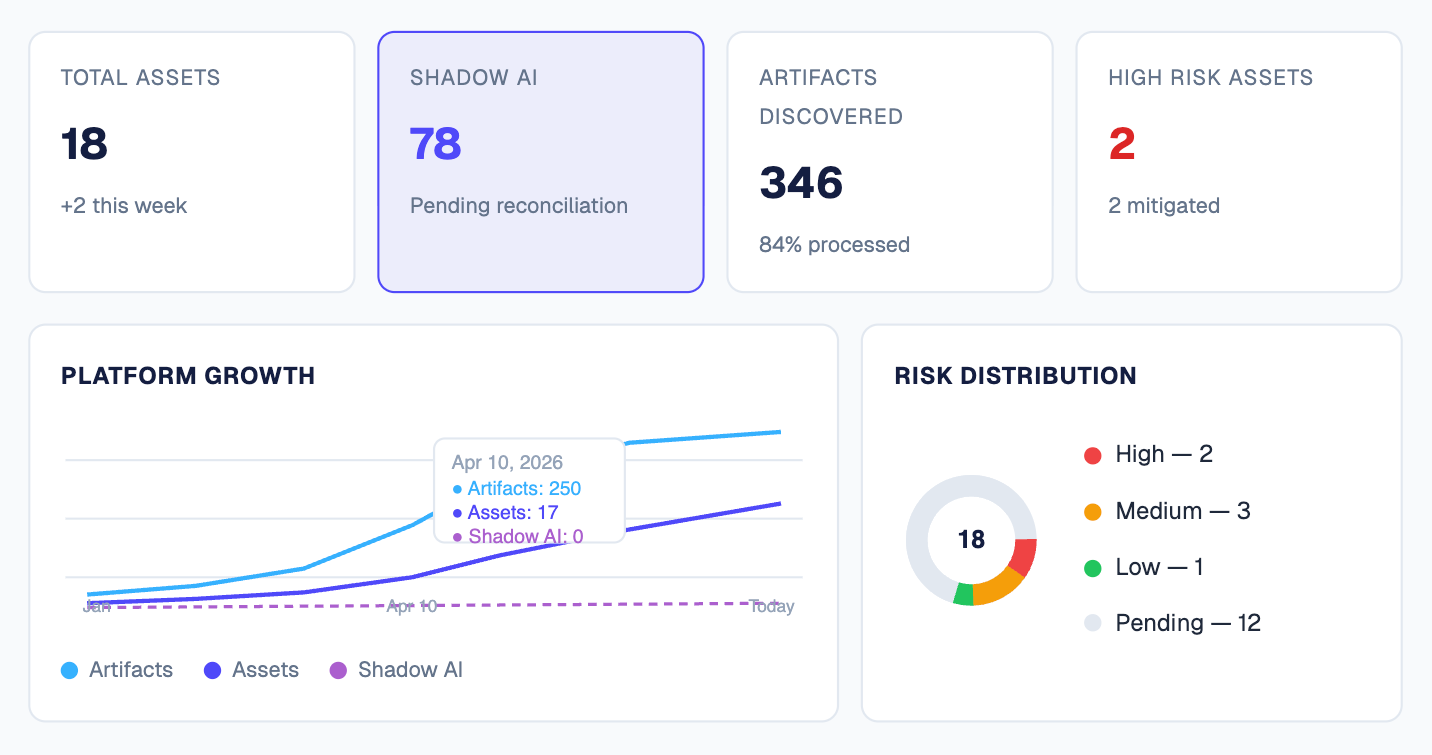
Previously, discovered ungoverned assets appeared alongside governed ones in the main AI inventory. Governance teams had to filter and sort to separate what needed attention from what was already under control. The Shadow AI tab creates a dedicated staging environment, a true working queue, separate from everything already governed.
Every asset in the tab shows three things:
- Source. Where it was discovered: Azure, GitHub, Databricks, or any connected platform.
- Artifact count. How many files and records make up that asset.
- Shadow AI Risk Score. Its consequence ranking, sortable and filterable.
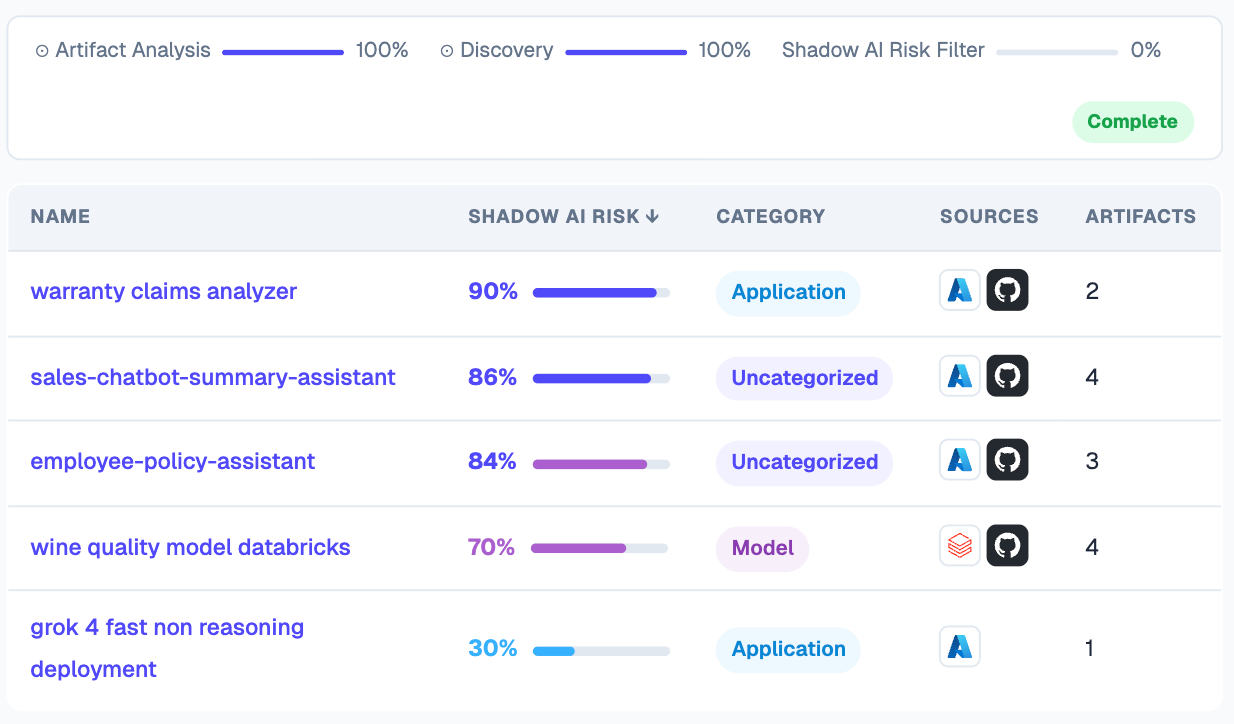
Governance teams open the tab, see exactly what needs a decision, and move on. Nothing is buried in a mixed list.
New: Shadow AI Risk Score
Not all shadow AI carries the same risk. A developer's internal productivity script is a different governance priority than a client facing recommendation engine processing sensitive customer data. Treating every discovered asset with the same urgency burns governance capacity on low stakes work while high stakes assets sit unreviewed.
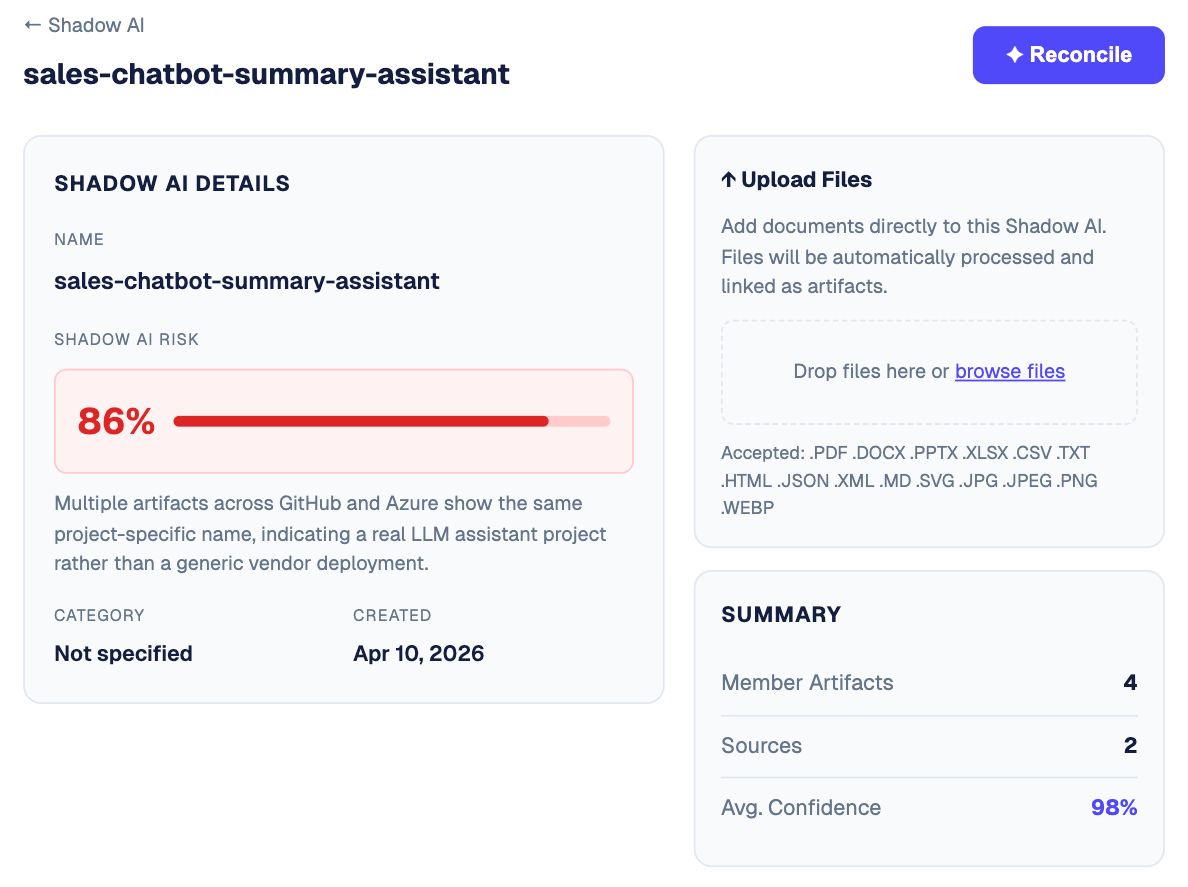
The Shadow AI Risk Score is a composite KPI that ranks every discovered asset by consequence. It draws on four input dimensions:
A low score means the asset can be reviewed at lower priority. A high score puts it at the top of the queue. Scores are filterable and sortable directly within the Shadow AI tab.
When leadership asks how ungoverned AI is being handled, the answer is no longer a spreadsheet. It's a scored, staged queue with audit history showing what was found, when it was triaged, and how it entered governance.
New: Upload & One-Click Reconciliation
Once a governance team reviews a shadow AI asset, acting on it used to mean starting over.: Create a new inventory item. Re-enter the metadata. Stand up a workflow from scratch.
Now, users work directly inside the shadow AI asset record in two steps:
- Upload documentation. Anything gathered offline, received from the asset owner, or exported from another system goes directly into the record before reconciliation.
- Click Reconcile. One click converts the shadow AI asset into a fully governed inventory item. All artifacts, source metadata, and uploaded documentation carry through automatically.
From there, the asset enters standard governance workflows: risk mapping, assurance testing, programmable controls, and ongoing monitoring. No re-entry. No duplication. Reconciled assets are also immediately subject to any active Programmable Controls. If a control triggers on asset creation, newly reconciled shadow AI assets are picked up without any manual task creation required.
New: Discovery Settings & Constraints
Shadow AI is only as good as what it's allowed to see. Discovery Settings give you precise control over what gets included in discovery before the algorithm runs. Think of it as input quality control for your Shadow AI output.
Two constraint types shape what the discovery engine builds from:
- Segregator. Creates processing boundaries. Artifacts on opposite sides of a boundary are treated independently, so teams, business units, or environments don't bleed into each other's clusters.
- Identifier. Drives asset linkage. Artifacts sharing the same identifier value are linked as the same asset, enabling the platform to group scattered components from GitHub, Azure, Databricks, and elsewhere into one coherent record.
The relationship between settings and output is direct. More activity signals and tighter identifier fields produce deeper, more accurate clusters. Broad, unfiltered discovery produces noisier results that take longer to triage.
How Holistic AI Shadow AI Discovery Works End-to-End
From first scan to governed inventory in just five steps, continuously updated.
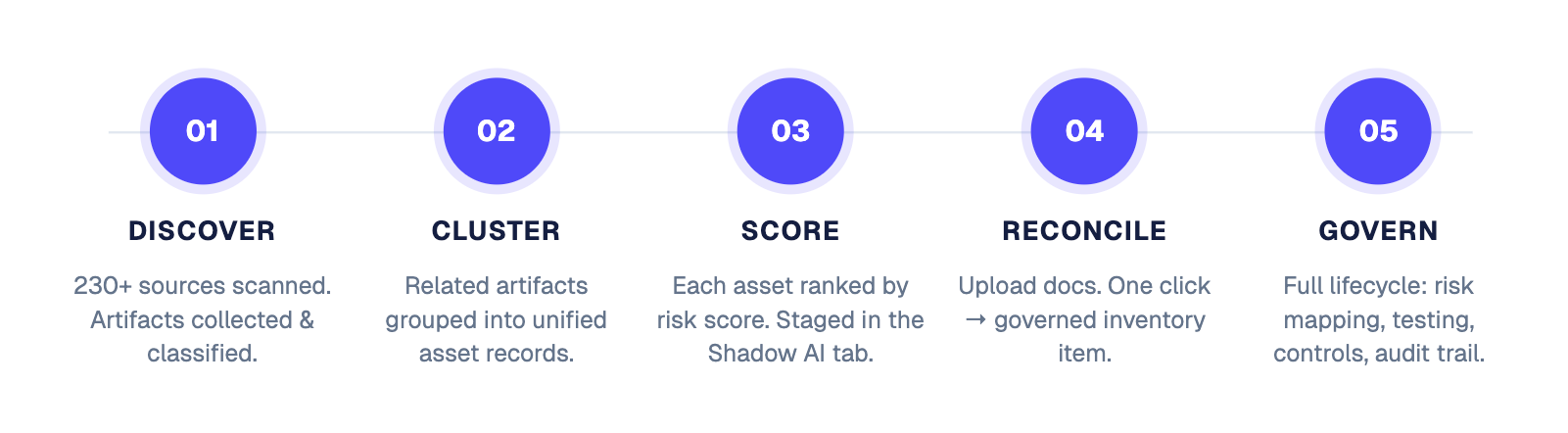
DISCOVER → SCORE → TRIAGE → RECONCILE → GOVERN
- Discover. The platform scans 230+ connected sources — cloud platforms, code repositories, ML platforms, LLM providers, agent and observability tools, documentation systems, enterprise systems, and SaaS tools — and identifies AI assets operating outside the governance perimeter.
- Score. Each asset is scored by the Shadow AI Risk Score and placed in the Shadow AI staging tab.
- Triage. Governance teams review the queue, prioritized by risk score, and investigate individual assets.
- Reconcile. Additional documentation can be uploaded directly into each asset record. One click converts it into a governed inventory item.
- Govern. The asset enters standard governance workflows. All artifacts, documentation, and audit history carry through from discovery to governance. Nothing gets lost in the handoff.
All artifacts, documentation, and audit history carry through from discovery to governance. Nothing gets lost in the handoff.
Why it matters
Different teams feel this problem differently.
- Governance teams: Risk scoring and one click reconciliation turn a discovery queue into an operational process. You stop cataloguing ungoverned AI and start closing it.
- CISOs and risk leaders: When leadeship asks how ungoverned AI is being handled, the answer is a scored, staged, timestamped queue with full audit history. Not a spreadsheet.
- Compliance teams: EU AI Act, NIST AI RMF, ISO 42001, and Local Law 144 all tighten documentation and inventory expectations. A clear, auditable pathway from discovered to governed is exactly what those requirements ask for. This release produces it automatically.
Technical details
- Supported sources. 230+ connectors across cloud platforms (AWS, Azure, GCP), code repositories (GitHub, GitLab, Bitbucket), ML platforms (Databricks, MLflow, Weights & Biases), LLM providers (OpenAI, Anthropic, Azure OpenAI, Google AI), agent and observability platforms (AgentOps, CrewAI, LangSmith, Langfuse), documentation systems (Confluence, SharePoint, Google Drive), enterprise systems (ServiceNow, Jira), data platforms (Snowflake), and SaaS tools (Slack, Notion). All connections are read-only, configured through the sources and connectors module.
- Risk score methodology. The Shadow AI Risk Score is calculated from asset metadata, artifact analysis, and configurable organizational parameters. Presented as a composite rating, filterable and sortable within the Shadow AI tab.
- Reconciliation workflow. When an asset is reconciled, the platform creates a new governed inventory item and transfers all associated artifacts, source metadata, and uploaded documentation. The asset appears in the main inventory with its full history intact, ready for workflow assignment.
- Programmable Controls integration. Reconciled assets automatically become subject to any active controls in the platform. Controls configured to trigger on asset creation or reconciliation pick up newly reconciled shadow AI assets automatically.
- Audit trail. Every step — from initial discovery through scoring, documentation upload, and reconciliation — is timestamped and attributed. The full lifecycle is visible in the asset's artifact library.
Part of the Holistic AI Governance Platform
Shadow AI Discovery feeds directly into the broader platform. Once an asset is reconciled, it enters the full IDENTIFY → PROTECT → ENFORCE lifecycle: risk classification, bias and safety testing, EU AI Act and NIST AI RMF compliance workflows, automated evidence collection, and continuous monitoring — all in one place.
One platform. From the first scan to the audit report.
Want to see Shadow AI Discovery in action? Get a demo.